
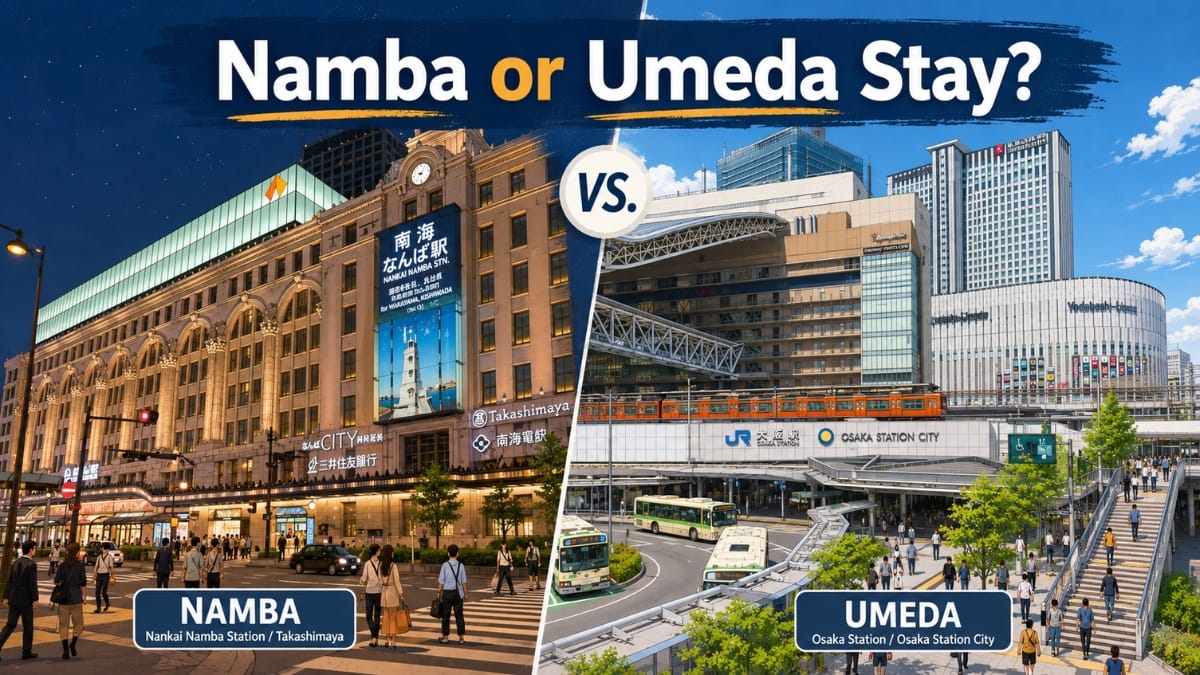
You feel the difference almost immediately. Step out in Namba and Osaka feels loud, bright, snack-filled, and constantly moving. Step out in Umeda and it feels bigger, cleaner-lined, and more businesslike, with major train connections built into the neighborhood. If you are deciding on a namba or umeda stay, that first impression matters more than people sometimes admit.
For first-time visitors, this is less about which area is “better” and more about which area makes your trip easier. Both are strong bases. Both are convenient. But they support different rhythms of travel, and choosing the right one can remove a lot of friction from your days.
Namba or Umeda stay: the short answer
If your Osaka trip is built around street food, nightlife, walkable sightseeing, and that energetic city atmosphere people often imagine before visiting Japan, Namba usually makes more sense. It places you close to Dotonbori, Kuromon Market, Den Den Town, Amerikamura, and many late-night dining options. It is the easier choice for travelers who want to step outside and feel like they are already in the middle of the action.
If your priority is smoother regional transport, easier access to Kyoto and Kobe, department-store shopping, and a calmer home base at night, Umeda is often the better pick. It sits around Osaka Station and Umeda Station, which makes it one of the most practical transport hubs in the city. For travelers planning multiple day trips, that convenience adds up quickly.
That is the short version. The more useful answer depends on how you travel.
Choose Namba if you want Osaka on your doorstep
Namba works well for visitors who want to explore on foot without overthinking the day. The area blends major attractions, food streets, casual shopping, entertainment, and easy train access in a way that feels intuitive even on a first trip.
This is where many travelers get their strongest “I am in Osaka” feeling. Dotonbori is nearby, but Namba is not only Dotonbori. The wider area includes old-school arcades, backstreet eateries, tiny bars, underground passageways, and neighborhoods with more personality than polish. If you like places that feel active from morning through late evening, Namba is a comfortable fit.
It also helps if your schedule is loose. Maybe you want to return to the hotel for a short rest, go back out for takoyaki, then wander again after dark. In Namba, that kind of flexible day is easy. You are not spending your best energy commuting back to your room just because dinner ran late.
There are trade-offs, though. Namba can feel crowded, especially around major commercial strips. Streets are busier, signage is louder, and the station area can be confusing at first because several rail lines and connected districts overlap. If you are a light sleeper or want a quiet, spacious-feeling neighborhood, hotel choice matters more here.
Who tends to prefer Namba
Namba is often the better base for couples, first-time Osaka visitors focused mainly on the city itself, food-first travelers, and anyone who enjoys nightlife without needing a club-heavy scene. It also suits shorter stays well. If you only have two or three nights in Osaka, being close to many headline sights can make the trip feel fuller with less effort.
Choose Umeda if you want convenience and range
Umeda is less chaotic in personality but stronger in infrastructure. This is one of Osaka’s major transport centers, and that changes the experience of staying there. If you are planning day trips to Kyoto, Kobe, Nara, or even moving on by long-distance rail, Umeda simplifies the logistics.
The neighborhood is dense with department stores, office towers, hotel clusters, restaurant floors, and underground walkways. It feels more polished and more vertical than Namba. Some travelers love that. Others find it a bit less memorable at street level. That difference is real, and it usually comes down to what kind of trip you want.
Umeda is especially good for travelers who prefer structure. You might spend the morning in Kyoto, return in the late afternoon, have dinner near the station, and head back to a comfortable hotel without weaving through entertainment crowds. If that sounds relaxing rather than dull, Umeda is probably your area.
There is also a practical comfort here for first-time visitors who feel anxious about navigating Japan. Osaka Station and the surrounding transport network are huge, but once you understand your route, Umeda can be a very efficient base. You are plugged into the wider Kansai region in a way Namba does not quite match.
Who tends to prefer Umeda
Umeda often suits travelers doing several day trips, visitors arriving or departing through major rail hubs, business-leisure travelers, and people who want a more orderly atmosphere at night. It can also be a smart choice if you value hotel quality and convenience over neighborhood character.
Transportation: where each area wins
For pure regional connectivity, Umeda has the edge. It is one of the easiest places in Osaka to base yourself if Kyoto and Kobe are high on your list. The station network is extensive, and that centrality saves time.
Namba is still highly connected, just in a different way. It is strong for southern Osaka, airport access options, and local city exploration. If your plan centers on Osaka neighborhoods more than repeated intercity day trips, Namba is usually convenient enough.
This is where many travelers overcomplicate the decision. Both areas are well connected by the standards of most cities. You are not choosing between convenient and inconvenient. You are choosing between two different kinds of convenience.
Food, nightlife, and atmosphere
If your evenings matter, Namba is hard to beat. The area is built for wandering, snacking, and changing plans halfway through the night. You can have a casual meal, stop for dessert, walk through a busy canal district, then end up in a tiny bar or late-night ramen shop without much planning.
Umeda has excellent food too, but the feeling is different. You get more restaurant floors, station-connected dining, shopping-complex options, and polished interiors. There are plenty of good meals here, but the experience is often more contained than spontaneous.
Neither is wrong. Namba feels more playful and street-based. Umeda feels more efficient and organized.
Shopping and sightseeing style
Umeda is stronger for major department stores and a broad, practical shopping experience. If you want fashion, cosmetics, household goods, gifts, and easy indoor browsing, it delivers. On rainy days, that matters more than people expect.
Namba offers a more mixed shopping experience. There are major stores, but also youth fashion, niche shops, anime and electronics pockets, market browsing, and streets where the fun comes from what you happen to notice rather than what you planned to buy.
For sightseeing, Namba also places you closer to several of the city areas many first-time visitors naturally gravitate toward. Umeda works better as a transport base from which you branch outward.
Hotel feel and budget reality
Price can vary in both areas depending on season, hotel class, and exact location, so there is no absolute rule. Still, the feel of the stay can differ.
In Namba, it is easier to end up in a hotel surrounded by nightlife, shopping streets, and late-night foot traffic. That can be exciting or tiring. It depends on your tolerance for noise and motion. Checking the exact location matters more than simply booking something labeled “Namba.”
In Umeda, hotels often feel more business-oriented or polished, especially around the station zones. Rooms may still be compact, because this is Japan, but the surroundings can feel calmer once you leave the busiest station interiors.
If you are traveling with parents, prefer early nights, or want a quieter reset after full sightseeing days, Umeda may feel easier. If you want the neighborhood itself to be part of the entertainment, Namba usually delivers more value.
So, should you book Namba or Umeda?
Pick Namba if Osaka is the main event and you want your trip to feel lively, local, and easy to enjoy without rigid planning. It is the stronger choice for food lovers, night owls, and first-time visitors who want to walk into the city and feel its energy right away.
Pick Umeda if Osaka is your base for a wider Kansai itinerary, or if you want cleaner logistics, easier station access, and a more composed atmosphere. It is often the smarter choice for travelers who measure a good hotel location by how smoothly the next day starts.
If you still feel torn, use one simple test. Picture your final evening in Osaka. If you imagine neon, street snacks, and wandering until late, book Namba. If you imagine an easy return from a day trip, a dependable dinner near the station, and a calm night before the next train, book Umeda.
Both can work well. The best choice is the one that makes Osaka feel less stressful and more like your kind of city.