
Landing in Kansai and facing your first Japanese ticket machine is not the moment most travelers want a transportation puzzle. If you’re wondering how to use ICOCA card, the short version is this: buy it once, tap in and out on trains, tap when boarding or leaving certain buses, and use it for small purchases at many convenience stores and stations.
For first-time visitors to Osaka, ICOCA is usually the easiest way to move around with less friction. You do not need to calculate the exact fare for every ride, and you do not need to buy a new paper ticket each time you switch neighborhoods. That matters in a city where you might move from Osaka Station to Namba, then over to Sumiyoshi or a smaller local stop later in the same day.
How to use ICOCA card for trains and buses
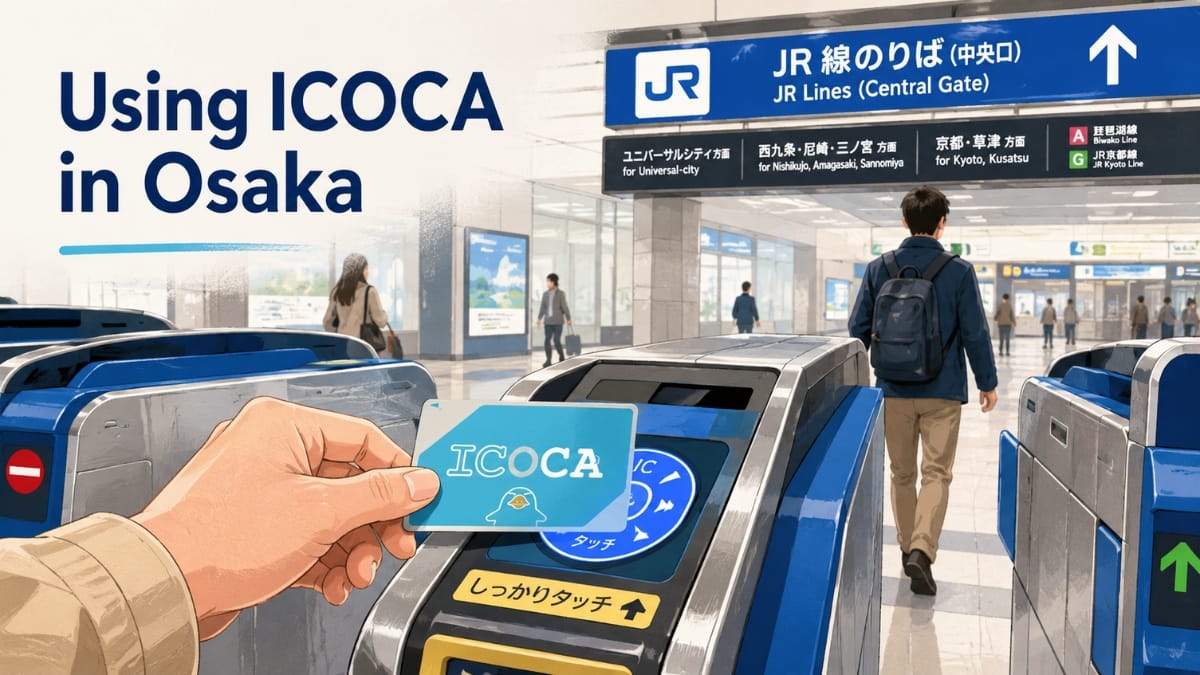
ICOCA is a rechargeable IC card issued in the Kansai region. Think of it as a stored-value transit card. You add money, then tap it on the reader at the ticket gate when entering and again when exiting. The fare is deducted automatically.
On trains in Osaka, this is usually very straightforward. At JR stations, private railway stations, and many subway gates, you place the card over the blue-lit reader for a second. You will hear a sound, the gate opens, and the screen shows your remaining balance. When you arrive, you tap out the same way.
Buses can be slightly less intuitive because the tap point depends on the operator and route. In many Osaka-area buses, you tap when boarding and sometimes again when getting off. The card readers are mounted near the entrance or exit. If you are unsure, watch one local passenger before moving. That small pause is often easier than trying to decode signs while people line up behind you.
One useful detail: keep the card separate when tapping. If it is buried in a wallet with multiple contactless cards, the machine may not read it properly. A simple card holder or an outer wallet pocket makes station gates much less stressful.
Where to buy an ICOCA card
You can usually buy ICOCA at major JR West stations in the Kansai area, including stations connected to Kansai International Airport. Ticket machines with IC card sales or service counters are the most common places to get one.
You typically pay an initial amount that includes a refundable deposit plus usable stored balance. The exact setup can change over time, so check the machine or counter screen when you buy. If you are arriving tired after a long flight, buying at the airport is often the easiest choice because you can start using it immediately for the ride into Osaka.
If a machine feels confusing, go to a staffed counter. This is one of those moments where a two-minute interaction can save you from choosing the wrong option or loading less money than you need for your first day.
How to charge an ICOCA card
Charging, or topping up, is simple once you’ve done it once. Use fare adjustment machines, ticket machines marked for IC cards, or convenience locations that support transit card reloads. In stations, insert the card, choose the amount, add cash if required, and confirm. The machine updates the balance in seconds.
Many travelers prefer to load a moderate amount rather than too much. Around one or two days of likely transit spending is often enough to start. That keeps things flexible, especially if your itinerary changes or you later decide to use day passes for certain routes.
It also helps to top up before your balance gets very low. Doing it during a quiet moment is easier than realizing you are short on funds at a busy gate during rush hour.
Where you can use ICOCA beyond Osaka
Although ICOCA is associated with Kansai, it is not limited to Osaka alone. In practice, it works across much of Japan’s major IC card networks for regular transit use. That means many visitors can continue using the same card in cities like Kyoto, Kobe, Tokyo, and beyond, depending on the route and operator.
That said, broad compatibility does not mean every transportation rule is identical. Long-distance intercity travel, reserved-seat limited express trains, and Shinkansen trips may need separate tickets or seat reservations. ICOCA is best thought of as a card for everyday local movement and small purchases, not as a universal pass for every rail scenario.
This is where some first-time visitors get tripped up. They assume one tap card covers every train in Japan. Often it does for local urban transit, but not always for premium or reservation-based services.
Using ICOCA for shopping
One reason travelers like ICOCA is that it works for more than trains. You can often use it at convenience stores, vending machines, station kiosks, coin lockers, and some restaurants or chain shops. If you see IC card payment signage near the register, there’s a good chance ICOCA is accepted.
The process is simple. Tell the cashier you want to pay by IC card if needed, then tap the card on the reader. The amount is deducted from the same balance you use for transit.
This is especially handy on travel days. If you are grabbing coffee near Shin-Osaka, buying water before a day trip, or picking up a quick snack in Namba Station, using ICOCA can be faster than sorting coins. Still, because it draws from the same balance, keep an eye on what remains if you still need train fare later that day.
Common mistakes first-time visitors make
The biggest mistake is forgetting to tap out. If you enter through a gate and do not complete the trip correctly, the card can register an incomplete journey. The next time you try to use it, the gate may reject the card until a station staff member or fare adjustment machine resolves it.
Another common issue is using too little balance. If your balance is insufficient when exiting, you usually cannot leave through the gate until you add funds or use a fare adjustment machine. This is not a disaster, but it can feel stressful if you are in a hurry.
Travelers also sometimes confuse JR lines with subways or private railways and assume every special train works the same way. In Osaka, the network is excellent but layered. ICOCA works across many systems, but certain trains still require an extra limited express ticket or a separate booking.
The last issue is physical handling. Bent cards, cards tucked behind multiple bank cards, or rushed tapping can all slow you down. A clean, deliberate tap solves most problems.
Should you get ICOCA or a rail pass?
It depends on how you travel. If your plan is mostly moving around Osaka, taking regular local trains, hopping on subways, and making flexible day trips, ICOCA is usually the easier choice. It gives you freedom without locking you into a fixed route or a prepaid period.
If you have a very specific itinerary packed with eligible rides, a regional pass can sometimes save money. But passes come with rules, coverage limits, and occasional confusion about which lines are included. For many first-time visitors, convenience matters as much as savings. Paying slightly more for a simpler system can be worth it if it helps your day run smoothly.
A practical middle ground is common too. Some travelers use ICOCA as their default card and only buy a pass on days when the math clearly works in their favor.
Refunds, returns, and what to do before leaving Japan
If you have money left on the card at the end of your trip, you generally have a few options. You can keep the card for future Japan travel, spend down the balance on transit or convenience store purchases, or in some cases request a refund through the issuing company under its current rules.
Refund policies can involve a handling fee and may need to be processed by the original issuer’s area or service counter. Because policies change, check the latest information at a JR West counter if you plan to return the card.
For many visitors, keeping the card is the easiest move, especially if there is any chance of returning to Japan. It is small, useful, and one less thing to figure out next time.
A simple ICOCA strategy for your first Osaka trip
If you want the low-stress version, buy the card when you arrive, load enough for your airport transfer and first day, and use it for regular city travel and convenience store stops. Check your balance whenever you pass a machine, and top up before it gets too low.
That approach works well for the kind of Osaka trip many readers are planning – a mix of major hubs, neighborhood wandering, and spontaneous stops that do not fit neatly into a rigid pass. The less time you spend decoding fare charts, the more time you get for the city itself: a quiet shrine visit, a late lunch in a local shopping street, or an easy train ride to a neighborhood you had not planned to love.
Once you’ve used ICOCA a few times, Osaka starts feeling much more navigable, and that confidence changes the whole trip.