
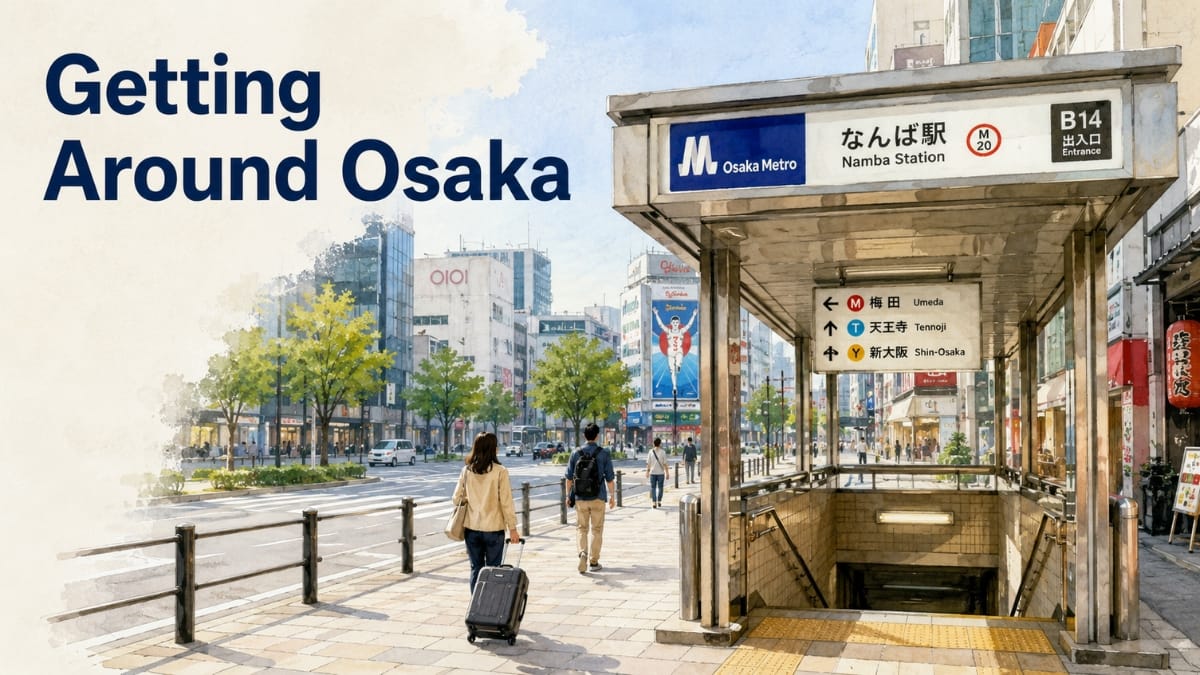
You do not need to memorize Osaka’s entire rail network to have a good trip here. If you are wondering how to get around Osaka, the easiest answer is this: use trains and subways for most trips, walk within neighborhoods, and treat buses, taxis, and rideshares as backup tools rather than your default.
That simple approach works because Osaka is dense, well connected, and easier to read once you stop thinking of it as one giant city and start thinking in neighborhoods. Umeda, Namba, Shinsaibashi, Tennoji, Shin-Osaka, and Osaka Castle area each function like clear travel zones. Once you know which zone you are heading to, the rest becomes much more manageable.
How to get around Osaka on your first trip
For most first-time visitors, rail is the answer. Osaka’s transportation system can look intimidating on a map because several companies operate lines in the city, but in practice, you will usually rely on just a few categories: the Osaka Metro, JR lines, and a handful of private railways if you are heading to places outside central Osaka or to specific neighborhoods.
The Osaka Metro is the most straightforward system for sightseeing within the city. It reaches many of the places first-time travelers actually visit, including Namba, Shinsaibashi, Umeda, Tennoji, and the area near Osaka Castle. If your hotel is close to a Metro station, your trip gets much easier immediately.
JR lines are also useful, especially if you are arriving from Kyoto, Kobe, Kansai Airport, or Shin-Osaka Station. The Osaka Loop Line is the JR line many visitors notice first because it circles key parts of the city. It can be helpful, but it is not always the fastest option for short trips inside central Osaka. Sometimes the subway is more direct.
Private railways matter when your Osaka plans stretch beyond the obvious center. If you are going to places such as Sumiyoshi Taisha, Ikeda, Sakai, or Nara as a day trip, you may use Hankyu, Hanshin, Keihan, Kintetsu, or Nankai lines. The main thing to know is that this is normal. Different operators do not mean you are doing something wrong.
The easiest way to think about Osaka transit
Instead of trying to learn every line name, learn the city by anchors. Umeda is the major north-side hub. Namba is the major south-side hub. Tennoji sits farther south and is very useful for airport access and certain local trips. Shin-Osaka is mainly for the Shinkansen, not for evening wandering or food-focused exploring.
If you can move comfortably between Umeda and Namba, you have already solved most of central Osaka. From there, short subway rides or local train connections take you almost everywhere a first-time traveler is likely to go.
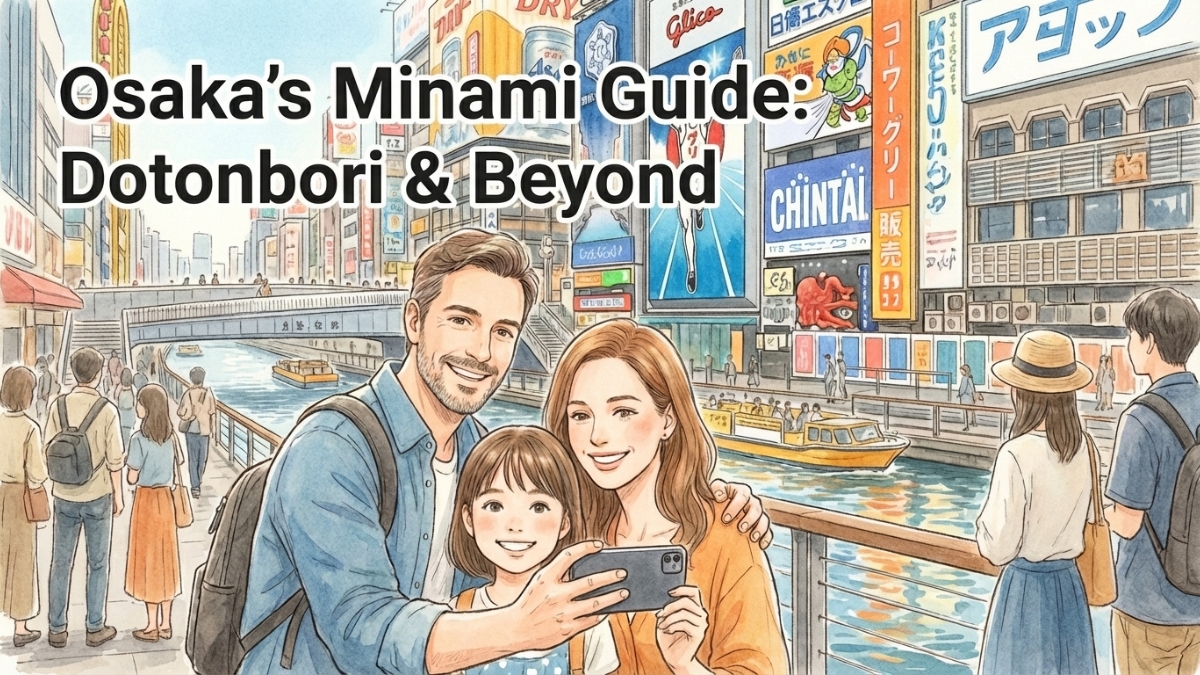
This is also why hotel location matters so much. Staying near Osaka Station or Umeda is convenient for regional day trips and intercity travel. Staying near Namba is often better if you want nightlife, food streets, walkable shopping, and easy access to areas like Dotonbori, Shinsaibashi, and Kuromon Market. Neither is universally better. It depends on your pace and priorities.
IC cards make Osaka much easier
The best low-stress move you can make is to use an IC card. These rechargeable transit cards let you tap in and out on most trains, subways, and buses without buying individual tickets every time.
For visitors, this removes a surprising amount of friction. You do not need to calculate fares before each ride, and you do not need to worry much about which operator runs which line. As long as the card is accepted, you tap and go.
This is especially helpful in Osaka because station complexes can be large and transfers can involve several ticket gates. Using an IC card lets you focus on signs and platforms instead of ticket machines.
If you prefer using your phone, mobile versions may be an option depending on your device and payment setup. If that sounds uncertain, a physical card is still the simplest choice.
When to use the subway, train, bus, or taxi
Subways are usually best for short city hops. Going from Namba to Umeda, Shinsaibashi to Tennoji, or reaching sightseeing areas inside central Osaka often feels most direct by Metro.
JR trains make sense when you are connecting from major stations, using the Loop Line, or traveling beyond the city center. If you are coming in from Kyoto or heading to Osaka Station areas, JR can be the easiest path.
Buses are the least beginner-friendly option, not because they are bad, but because they require more local familiarity. Stops can be harder to identify quickly, boarding systems vary, and traffic can slow things down. If a bus gives you a direct route to a specific attraction, take it. Otherwise, trains are usually simpler.
Taxis are useful in very specific situations: late at night after trains stop, traveling with heavy luggage, moving short distances in bad weather, or getting to a restaurant or neighborhood that is awkward to reach by rail. Osaka taxis are generally reliable and safe, but costs rise quickly compared with rail. For one or two people on a normal sightseeing day, they are more of a convenience purchase than a practical default.
Walking in Osaka is part of the plan
One mistake first-time visitors make is assuming every movement needs a train ride. In Osaka, some of the best areas are experienced on foot once you arrive.
Namba, Shinsaibashi, Dotonbori, and Amerikamura blend into each other more than many travelers expect. You can cover a lot there just by walking, and that is often how you notice the smaller cafes, side-street shops, shrines, and local food spots that do not show up on generic itineraries.
The same logic applies in parts of Umeda, although the environment is more vertical and station-centered. Underground passages, department stores, and connected buildings can make the area feel confusing at first. Give yourself extra time there. It gets easier once you accept that Osaka Station and Umeda are not a quick in-and-out environment.
Comfort matters too. Osaka rewards walking, but long station corridors, stairs, and summer heat can wear you down. If your day already includes a lot of temple grounds, shopping streets, or castle park walking, it may be worth taking one extra train stop instead of trying to force everything on foot.
Common transit mistakes in Osaka
The biggest mistake is choosing hotels based only on price while ignoring station access. A cheaper room can become frustrating if every morning starts with a long walk to a minor station and multiple transfers.
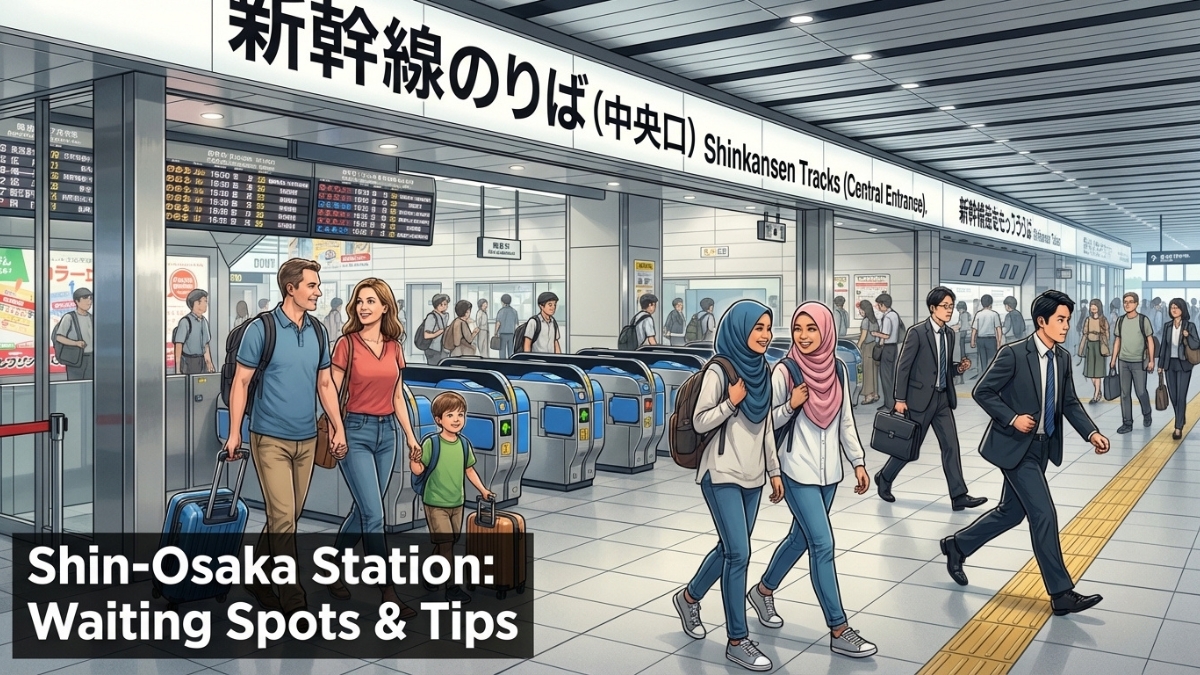
Another common issue is confusing Osaka Station with Shin-Osaka Station. They are not the same place. Shin-Osaka is a practical rail hub for the bullet train, while Osaka Station sits in the Umeda area where many travelers actually shop, eat, and connect onward.
Visitors also underestimate how large some stations are. Namba and Umeda can eat up time if you pick the wrong exit or transfer point. Build in a few extra minutes, especially on your first day.
And while rail apps are very helpful, do not follow them blindly. The fastest route is not always the easiest route. Saving three minutes is not worth a complicated transfer if you are tired, carrying bags, or trying to make a timed reservation.
How to get around Osaka with luggage or on arrival day
Arrival day is when Osaka can feel most confusing. You are tired, your phone battery may be low, and even clear signage feels harder than it should.
If you are landing at Kansai International Airport, choose the route that gets you closest to your hotel with the fewest decisions. For some travelers that means taking an airport train to Namba. For others it means heading toward Tennoji or Umeda depending on where they are staying. There is no prize for taking the most technical route.
If you have large luggage and your hotel is not close to a simple station exit, a taxi for the final stretch can be worth it. That small decision can make the first few hours of your trip much calmer.
A practical mindset for getting around Osaka
The travelers who handle Osaka best are not the ones who memorize everything in advance. They are the ones who keep their days geographically sensible. Group Namba and Shinsaibashi together. Pair Umeda with nearby north-side plans. Keep Tennoji and southern sights for the same day when possible.
That approach reduces transfers, cuts walking fatigue, and gives you more room to notice the city itself. Osaka is not a place where you need to move perfectly. It is a place where a clear base, a good IC card, and a neighborhood-by-neighborhood plan will take you very far.
If you stay flexible and choose the easiest route over the most impressive one, getting around Osaka starts to feel less like a test and more like what it should be – the simple part of a very good trip.