
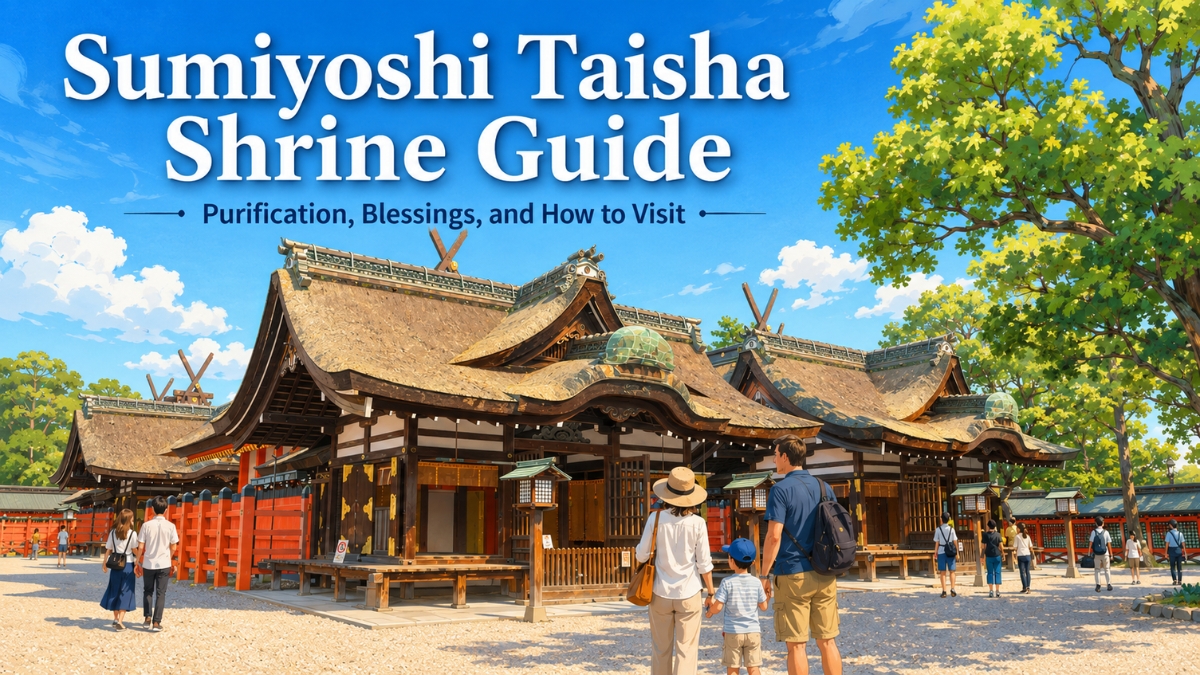
Sumiyoshi Taisha is one of Osaka’s most important Shinto shrines. It is located in Sumiyoshi Ward, south of Namba, and is known for its red arched bridge, four National Treasure shrine buildings, sea-protection deities, purification rituals, and local Osaka nickname, Sumiyossan.
Some Japanese articles or social media posts say things like “there is no deity at Sumiyoshi Taisha” or “you are called by the shrine.” For first-time visitors from overseas, these phrases can be confusing. They should not be taken literally.
A Shinto shrine is a sacred place connected with kami, often translated as deities or divine presences. People visit shrines to give thanks, pray for protection, ask for guidance, or mark important life events. At Sumiyoshi Taisha, many visitors come for purification, safe travel, business prosperity, safe childbirth, poetry, performing arts, and personal renewal.
This guide explains what Sumiyoshi Taisha is, how to visit respectfully, what its “blessings” mean in Japanese culture, which spots to see, and how to avoid common mistakes.
What Makes Sumiyoshi Taisha Important?
One of Osaka’s Oldest and Most Respected Shrines
Sumiyoshi Taisha has stood in Osaka for almost 2,000 years. It is the head shrine of roughly 2,300 Sumiyoshi shrines across Japan and has long been connected with the sea, safe voyages, Osaka’s port history, poetry, performing arts, business, love, and safe childbirth.
The shrine enshrines the Sumiyoshi Sanjin, three sea deities, together with Empress Jingū, who is traditionally connected with the shrine’s foundation. Historically, people involved in fishing, shipping, trade, and travel prayed here for protection.
For travelers, this makes Sumiyoshi Taisha more than a photo spot. It is a living shrine where local people still pray, join festivals, receive amulets, and visit at major turning points in life.
What “Blessings” Mean at a Japanese Shrine
In English, Japanese gōriyaku is often translated as “benefits” or “blessings,” but this can sound too automatic. A shrine blessing is not a guaranteed result.
A better way to understand it is this: people visit a shrine to pray, give thanks, reset their mind, and ask for spiritual support. After that, they still need to act responsibly in daily life.
For example, a person may pray at Sumiyoshi Taisha for safe travel. That does not mean they can ignore safety rules. It means they ask for protection, then travel with more care and gratitude.
Why Do Some People Say “There Is No Deity” at Sumiyoshi Taisha?
It Is Usually a Feeling, Not a Literal Claim
Some visitors describe Sumiyoshi Taisha as very open, bright, or unusually calm. Compared with forested mountain shrines, its atmosphere can feel less heavy and more spacious.
That feeling sometimes leads people to say, “I could not feel the deity,” or “the shrine felt empty.” This is not an official teaching, and it does not mean the shrine has no kami.
Sumiyoshi Taisha’s main buildings are known for a simple, ancient architectural style called sumiyoshi-zukuri. The straight roofs and clean lines are part of the shrine’s character. The current four main sanctuaries were built in 1810 and are designated National Treasures.
For overseas visitors, it is better to read this atmosphere as clarity, not absence.
The Shrine Is Strongly Connected With Purification
The Sumiyoshi deities are connected with the sea and with purification. The shrine’s official English explanation notes that the patron deities came into being when Izanagi purified himself in the sea after returning from the underworld.
This background helps explain why many people associate Sumiyoshi Taisha with cleansing, renewal, and starting again.
If you feel calm rather than dramatic emotion, that is not a failure. In shrine culture, a quiet, neutral mind can itself be a good result.
Access to Sumiyoshi Taisha
How to Get There from Central Osaka
Sumiyoshi Taisha is located at 2-9-89 Sumiyoshi, Sumiyoshi-ku, Osaka. The easiest route for many visitors is by train from Namba on the Nankai Line.
Location: Sumiyoshi Ward, Osaka
Nearest stations: Sumiyoshi Taisha Station, Sumiyoshitorii-mae Station, Sumiyoshi Station
Access from Namba: Take the Nankai Line to Sumiyoshi Taisha Station, then walk a few minutes
Admission: Free
IC card: Major IC cards such as ICOCA and Suica can generally be used on Osaka-area railways
Best time: Morning or early afternoon
Watch out for: New Year and major festival periods are very crowded
The official access page lists the opening time as 6:00 from April to September and 6:30 from October to March. The outer gate closes at 16:00, while the inner sacred area closes at 17:00. Special periods such as New Year and Sumiyoshi Matsuri may have different hours.
Helpful links:
Official site: Sumiyoshi Taisha
FAQ: Sumiyoshi Taisha FAQ
Google Maps: Sumiyoshi Taisha on Google Maps
How to Pray at Sumiyoshi Taisha
Basic Shrine Etiquette for First-Time Visitors
At a Shinto shrine, visitors usually follow a simple prayer style:
- Bow lightly before entering the shrine grounds.
- Walk calmly through the approach.
- If available, rinse your hands at the purification basin.
- Stand before the worship hall.
- Put a small coin into the offering box.
- Bow deeply twice.
- Clap twice.
- Pray quietly.
- Bow deeply once.
You do not need perfect Japanese. A quiet prayer in English is acceptable.
A respectful prayer might be:
“Thank you for this visit. Please help me travel safely and live with a clear mind.”
What Not to Do
The shrine’s FAQ asks visitors to refrain from eating, drinking, and smoking on the shrine grounds. Drones are also prohibited. It also states that the shrine does not provide Wi-Fi and that credit cards are not accepted for the souvenir shop or Nankun-sha Shrine; purchases must be made in Japanese yen cash.
Bring small coins and cash if you plan to make offerings, receive amulets, or visit sub-shrines.
Spots to See Inside Sumiyoshi Taisha
Sorihashi Bridge: The Famous Red Arched Bridge
The red arched bridge near the entrance is called Sorihashi, also known as Taikobashi, or “drum bridge.” It is one of the shrine’s most recognizable sights.
The bridge is about 20 meters long, 3.6 meters high, and has a maximum slope of about 48 degrees. The shrine explains that crossing it is traditionally believed to be an act of purification.
Location: Near the main entrance
Cost: Free
Best for: First-time visitors, photos, symbolic purification
Watch out for: The bridge is steep. Use care, especially with children, older visitors, or wet weather
Recommended action: Cross slowly, hold the handrail, and avoid stopping in the middle when it is crowded.
This bridge is beautiful, but it is also a sacred approach. Take photos respectfully and do not block other visitors.
The Four Main Shrines: National Treasure Architecture
Sumiyoshi Taisha’s four main sanctuaries are built in the ancient sumiyoshi-zukuri style. The official English site explains that the current structures date from 1810 and are designated National Treasures.
The style is simple and straight-lined, unlike many later shrine buildings that show influence from Buddhist or continental Asian architecture. For visitors interested in architecture, this is one of the most important reasons to visit.
Location: Central shrine area
Cost: Free to view from outside
Best for: Shrine architecture, history, cultural understanding
Watch out for: Do not enter restricted areas or photograph where signs prohibit it
Recommended action: Take your time. The clean design is part of the shrine’s spiritual atmosphere.
Goshogozen: Finding the “Go-Dai-Riki” Stones
Goshogozen is a sacred area where visitors look for three small stones marked with the characters 五 meaning “five,” 大meaning “large,” and 力 meaning “power.” The shrine explains that the “five” refers to five blessings: health, wisdom, wealth, happiness, and longevity. A complete set of stones is believed to help make wishes come true.
For foreign visitors, this is a helpful example of a “participatory” shrine custom. You are not only looking at the shrine; you are quietly taking part in a prayer tradition.
Location: Near the main shrine area
Time: Available from opening until 16:00; amulet bags are available from 9:00 according to the shrine’s access page
Cost: Free to look for stones; amulet bags require a separate offering
Best for: Visitors who want a hands-on shrine experience
Watch out for: Do not take random stones outside the custom, and follow shrine instructions
Recommended action: Look quietly, avoid blocking others, and treat the stones respectfully.
Omokaru-ishi: Fortune-Telling Stones
At Ōtoshi-sha, visitors can try Omokaru-ishi, a set of stones used to reflect on whether a wish or goal may come true. The ritual is simple: pray, lift one stone, remember how heavy it feels, make your wish, then lift the same stone again. If it feels lighter the second time, the wish is considered more likely to come true. If it feels heavier, it may mean more effort is needed.
This should not be treated as a strict prediction. It is better understood as a traditional way to reflect on your readiness and commitment.
Location: Near Ōtoshi-sha
Time: Opening to 16:00 according to the shrine’s access page
Cost: Free
Best for: A short cultural experience
Watch out for: Lines may form on busy days
Recommended action: Keep your wish simple and do not rush other visitors.
Hattatsu Mairi and Nankun-sha: Business Prosperity and Beckoning Cats
What Hattatsu Mairi Means
Sumiyoshi Taisha is also known for Hattatsu Mairi, a prosperity-related shrine visit connected with business development and steady progress. The word “hattatsu” can suggest growth or development, which is why many business owners and workers are interested in it.
One important stop is Nankun-sha, which is associated with the dedication and hard work required to run a business. Hattatsu Mairi hours at Nankun-sha are listed as 6:00 to 15:45, with a prayer donation of 1,500 yen.
Location: Nankun-sha, inside Sumiyoshi Taisha grounds
Time: 6:00–15:45 for Hattatsu Mairi at Nankun-sha
Cost: Prayer donation listed as 1,500 yen
Best for: Visitors interested in business blessings or local Osaka merchant culture
Watch out for: This is a religious rite, not a business guarantee
Recommended action: Visit respectfully and understand the meaning before receiving charms.
Shōfuku Neko: Beckoning Cat Charms
Nankun-sha offers clay beckoning cat figurines called shōfuku neko for visitors performing Hattatsu Mairi. Cats with the left paw raised are associated with attracting customers and are offered in odd-numbered months. Cats with the right paw raised are associated with financial wealth and are offered in even-numbered months.
For overseas visitors, these are not simply cute souvenirs. They are part of a local prayer custom.
If you receive one, treat it as a shrine charm and keep it respectfully.
Other Blessings at Sumiyoshi Taisha
Sumiyoshi Taisha is not only about purification. The shrine’s official English overview also connects it with poetry, performing arts, love, business, and safe delivery of babies.
This range may surprise foreign visitors, but it reflects how Japanese shrines often develop many layers of worship over centuries. A shrine can be connected with sea travel, childbirth, literature, business, and local community life at the same time.
Suitable prayers may include:
- Safe travel
- Family safety
- A fresh start
- Business growth
- Safe childbirth
- Creative work
- Gratitude for daily life
Avoid thinking of the shrine as a vending machine for wishes. A shrine visit is a respectful act of prayer and reflection.
When to Visit Sumiyoshi Taisha
Early Morning for a Calmer Visit
If you want a quieter atmosphere, morning is best. The shrine opens at 6:00 from April to September and 6:30 from October to March. The opening time is also 6:00 on the first day of each month and on Hattatsu days.
Morning visits are easier for first-time visitors because the grounds are calmer and the light around Sorihashi Bridge is beautiful.
Avoid New Year if you dislike crowds. The shrine is famous for hatsumōde, and the official English site says about two million people come each January for the first shrine visit of the year.
Facilities and Practical Notes
The shrine’s amulet office is open 9:00–17:00, and prayer reception is 9:00–15:50 according to the official access page. Credit cards are not accepted at the souvenir shop or Nankun-sha, so bring Japanese yen in cash.
Parking is available but paid. The FAQ lists passenger car parking at 200 yen per 30 minutes, although this may vary during peak season.
Public transport is easier for most visitors.
If You Feel “Nothing” at the Shrine
Some visitors expect a dramatic spiritual feeling. They may read online posts about being “called” by the shrine or feeling strong energy, then feel disappointed if nothing happens.
It is better not to chase a special feeling.
At Sumiyoshi Taisha, calm itself can be meaningful. If you feel clear, quiet, or neutral, that can be a good sign. You have visited a sacred place, behaved respectfully, and taken time to slow down.
For foreign visitors, the most important result is not a mysterious experience. It is understanding the place better and leaving with a calmer mind.
Common Mistakes to Avoid
Mistake 1: Taking “No Deity” Literally
Sumiyoshi Taisha is an active Shinto shrine with a long history and living worship traditions. “No deity” is an informal feeling some people describe, not an official fact.
Mistake 2: Calling It a Temple
Sumiyoshi Taisha is a Shinto shrine, not a Buddhist temple. Use “shrine” in English.
Mistake 3: Treating Blessings as Guarantees
Do not say “this shrine will definitely reset your life” or “this charm will make you rich.” A better phrase is: “People traditionally pray here for purification, safety, business prosperity, and protection.”
Mistake 4: Rushing Through the Grounds
The shrine has many important areas. If you only cross the bridge, take a photo, and leave, you miss much of the experience.
Mistake 5: Ignoring Cash Needs
Bring cash for offerings, amulets, and special prayers. The shrine FAQ says credit cards are not accepted at the souvenir shop or Nankun-sha.
Mistake 6: Blocking Paths or Taking Intrusive Photos
Do not block Sorihashi Bridge, the main shrine approach, or people praying. Avoid photographing worshippers closely without permission.
Local Tips for First-Time Visitors
Use the Nankai Line from Namba
For many travelers, the Nankai Line from Namba is the simplest route. Sumiyoshi Taisha Station is close to the shrine, and the route is easier than changing between multiple local lines.
Walk Slowly Across Sorihashi Bridge
The bridge is steep. Take your time. If you have heavy luggage, mobility concerns, or small children, use caution or choose an easier route around it.
Bring Small Coins
Offerings at shrines are often small coins. Five-yen coins are popular because the word for five yen, go-en, sounds like the word for good connection or good relationship, but any small coin is acceptable.
Visit Nearby Local Streets
The area around Sumiyoshi Taisha has a calmer, more residential atmosphere than Umeda or Namba. After visiting, walk slowly and enjoy the local side of Osaka.
Final Advice
Sumiyoshi Taisha is not a place where “the deity is absent.” It is a bright, open, ancient shrine with a strong tradition of purification, sea protection, safe travel, and local Osaka worship.
For foreign visitors, the best way to visit is simple: understand that it is a Shinto shrine, bring cash, follow basic shrine manners, cross Sorihashi Bridge carefully, and take time to see the main shrines, Goshogozen, Omokaru-ishi, and Nankun-sha.
You do not need to feel anything dramatic. A quiet, respectful visit is enough. Sumiyoshi Taisha’s value is in its clarity, history, and the calm feeling of leaving a sacred place a little lighter than when you arrived.