
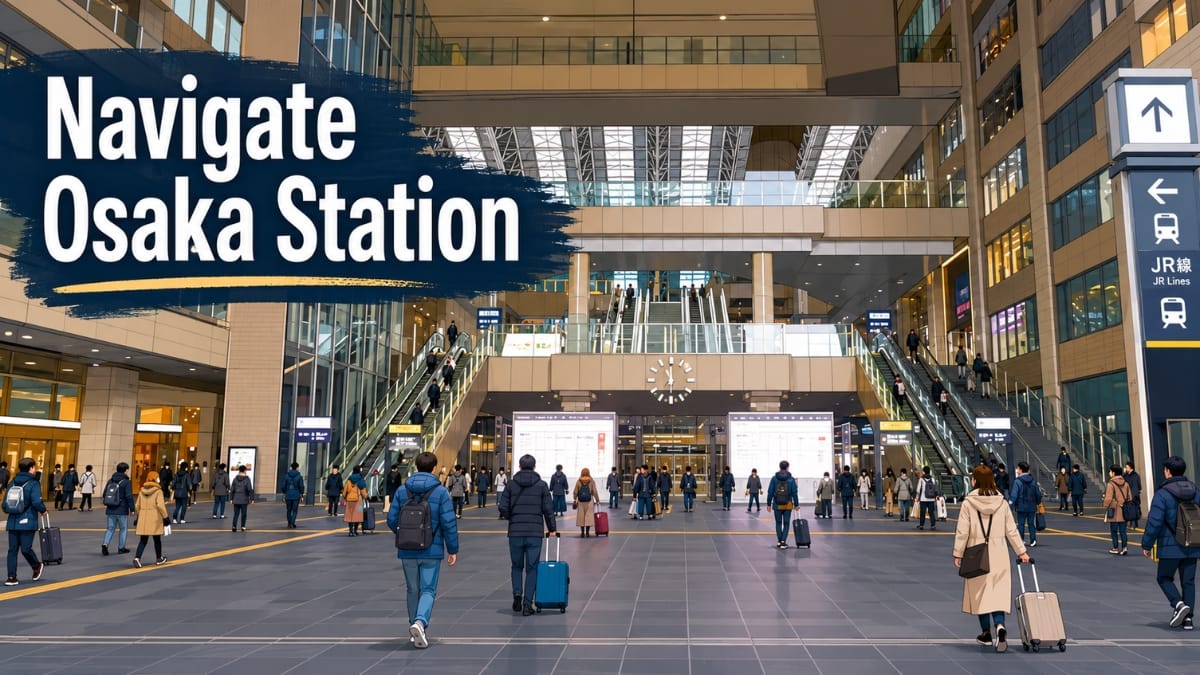
If you are trying to figure out how to navigate Osaka Station, the hardest part is not the trains. It is understanding that “Osaka Station” is really a cluster of connected stations, malls, underground passages, and rail operators spread across the Umeda area. Once that clicks, the station starts to feel less like a maze and more like a set of zones.
For first-time visitors, Osaka Station can feel bigger and busier than expected. You may come up from one platform and suddenly be in a department store, follow signs for Umeda and find yourself in a different building, or realize that your next train leaves from a separate railway company altogether. That confusion is normal. The good news is that the station is manageable if you stop thinking of it as one single terminal.
How to navigate Osaka Station by understanding the bigger picture
The most useful mental shortcut is this: JR Osaka Station is the main station for JR trains, while the surrounding Umeda area includes other major stations like Osaka-Umeda Station on Hankyu, Osaka-Umeda Station on Hanshin, and Umeda Station on the Osaka Metro. They are connected, but they are not the same station.
This matters because many travelers search for “Osaka Station” when they really mean the entire Umeda transit district. If your hotel says it is near Umeda, that does not always mean you should follow signs only for JR Osaka Station. In some cases, the closest route is through a subway concourse or a department store passage.
Inside JR Osaka Station itself, the layout is more straightforward than the wider district. You mainly need to know whether you are heading to a platform, a central gate area, the north side, the south side, or an underground connection.
Start with the two anchors: north and south
When learning how to navigate Osaka Station, focus on the station’s two main sides.
The south side connects to the older commercial heart of Umeda, with major department stores, Osaka Metro connections, and a lot of underground shopping corridors. If you are heading toward subway lines, Hanshin, or many central Umeda meeting points, south is often the side you want.
The north side leads toward the newer Grand Front Osaka area and wider pedestrian spaces. It feels more open and can be easier for first-time visitors to orient themselves in. If someone tells you to meet near Grand Front or LUCUA, you are generally working around the JR Osaka Station north side.
If you get lost, return to a large gate area and check whether signs point you north or south. That simple reset can save you a lot of circling.
Use gates and floors, not just exits
A common mistake is relying only on exit names too early. In Osaka Station, it is often easier to orient yourself by gate name, floor level, and nearby landmark before you worry about the final exit.
For example, if you know you need the Osaka Metro Midosuji Line, your goal is not just “find the right exit.” Your first goal is to reach the underground concourse on the south side, where subway signage becomes much clearer. If you need Hankyu, it is often easier to first aim for the upper or street-level routes toward the east side of Umeda rather than wandering underground too soon.
Think in stages. First reach the correct side of JR Osaka Station. Then follow signs for the railway company or landmark you need. Then confirm the line and platform.
The station signs are good, but they reward patience
English signage in Osaka Station is generally reliable. The issue is not poor signs. The issue is the volume of information around you. You may see signs for trains, shopping floors, underground malls, bus terminals, and nearby buildings all at once.
When that happens, slow down and look up. The clearest directional signs are usually overhead, not at eye level inside shops. If you keep walking while scanning side walls and storefronts, it is easy to drift off route.
It also helps to follow the color-coded transit signs rather than brand signs for shops or malls. Commercial signage is everywhere in Umeda, and it can pull you away from the station path without you realizing it.
Transfers that confuse first-time visitors
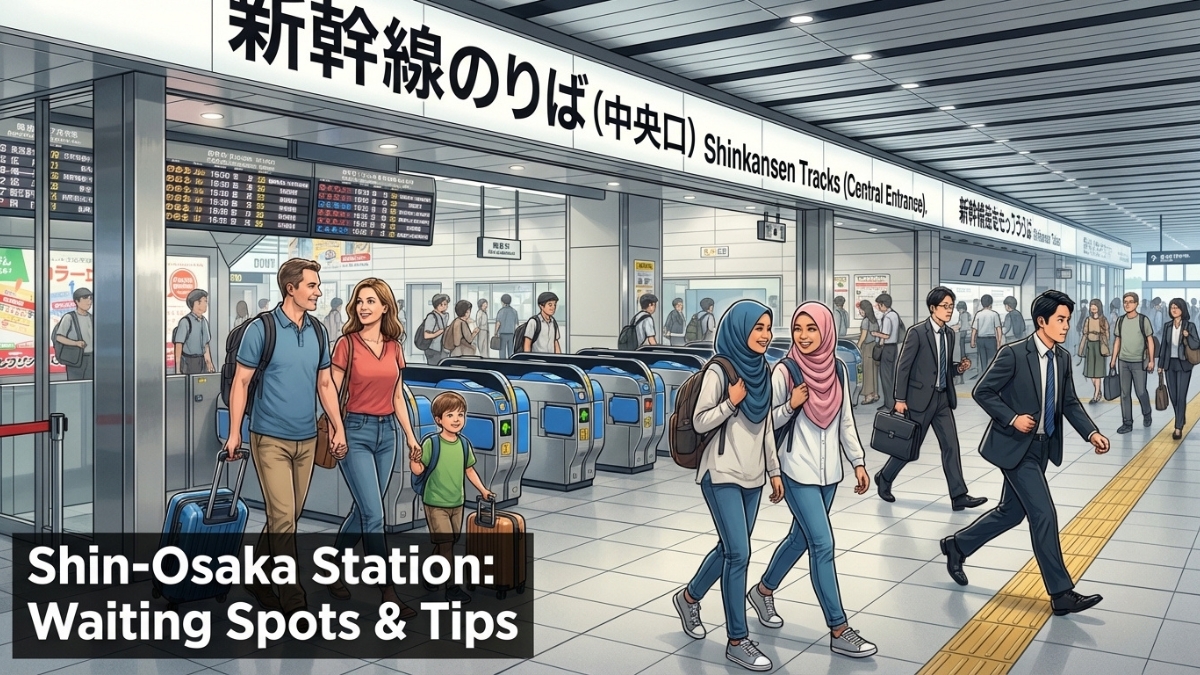
The most common point of friction is transferring between JR and non-JR lines. A traveler may arrive on a JR train and assume the subway platforms are inside the same paid area. Usually they are not. You often need to exit one operator’s gate area and walk through a public concourse before entering another.
This is especially true if you are transferring to Osaka Metro, Hankyu, or Hanshin. The walk is not necessarily hard, but it can feel longer than expected. Give yourself extra time, especially during rush hour or if you are carrying luggage.
Another confusion point is the name Umeda itself. In practice, locals may say Umeda even when talking about destinations connected to Osaka Station. Visitors who expect one clearly unified station may think they took a wrong turn when they see Umeda signs instead of Osaka signs. Usually, you are still in the right area.
How to navigate Osaka Station with luggage
Osaka Station is walkable with luggage, but it depends on timing and route choice. During weekday commuting hours, the main passages can get crowded fast. If you have large suitcases, avoid making tight transfers with only a few minutes to spare.
Elevators exist, but they are not always the fastest option because they may be slightly off the most direct route. Escalators are more common, but not every passage has one exactly where you want it. If comfort matters more than speed, build in 10 to 15 extra minutes.
Coin lockers are available in and around the station complex, though the nearest bank of lockers may already be full during peak travel periods. If you are planning a quick stop in Umeda before hotel check-in, it is smart to expect some trial and error.
Best way to avoid getting lost
The calmest approach is to use landmarks, not just platform numbers.
Inside and around Osaka Station, memorable landmarks help more than abstract directions. LUCUA, Grand Front Osaka, the South Gate area, and major department stores are easier to recognize than a chain of small corridor names. If your route includes one major landmark at a time, you can course-correct more easily.
It also helps to screenshot your route before you arrive. Mobile data can be slow underground, and station interiors do not always display exactly the same names your map app uses. A saved map view gives you a stable reference when signs and app directions do not line up perfectly.
If you feel disoriented, do not keep pushing deeper into underground passages hoping it will make sense. Go back to a large open concourse, find an overhead area map, and re-anchor yourself. In Osaka Station, small wrong turns can compound quickly.
Where to meet someone at Osaka Station
Meeting inside the station can be harder than catching the train. “I’m at Osaka Station” is not enough because the area is too large and has multiple levels.
Choose a specific gate, a clearly named plaza, or a well-known landmark on either the north or south side. Department store entrances and large station gates work better than “near the shops” or “by the escalator.” If one person is arriving by JR and the other by subway, agreeing on a place above ground is usually easier than trying to synchronize inside the underground network.
Food, bathrooms, and breaks when you need a reset
One reason Osaka Station overwhelms people is that it combines transportation with heavy retail traffic. The upside is that if you need a breather, you can usually find one.
There are plenty of food options, from quick cafes to full restaurant floors, but some are tucked inside shopping buildings rather than directly on the station path. Bathrooms are also widely available, though finding the nearest one can take a few extra minutes if you are between gate areas.
If you are stressed, step out of the flow for five minutes. A short pause near a station map or open plaza often works better than trying to problem-solve while moving with the crowd.
A simple first-timer strategy for Osaka Station
When you arrive, do three things before moving fast: check which railway company you need next, confirm whether your destination is north or south of JR Osaka Station, and look for the nearest major sign overhead. That sequence prevents most avoidable mistakes.
If your trip through Umeda includes multiple transfers, treat Osaka Station like a district rather than a building. That mindset changes everything. You stop expecting one neat station hall and start looking for connected zones, which is much closer to how the area actually works.
After one or two passes, the logic becomes familiar. And once it does, Osaka Station shifts from intimidating to useful – a place where trains, shopping, food, and the rest of Umeda all come together in a way that makes Osaka surprisingly easy to explore.