
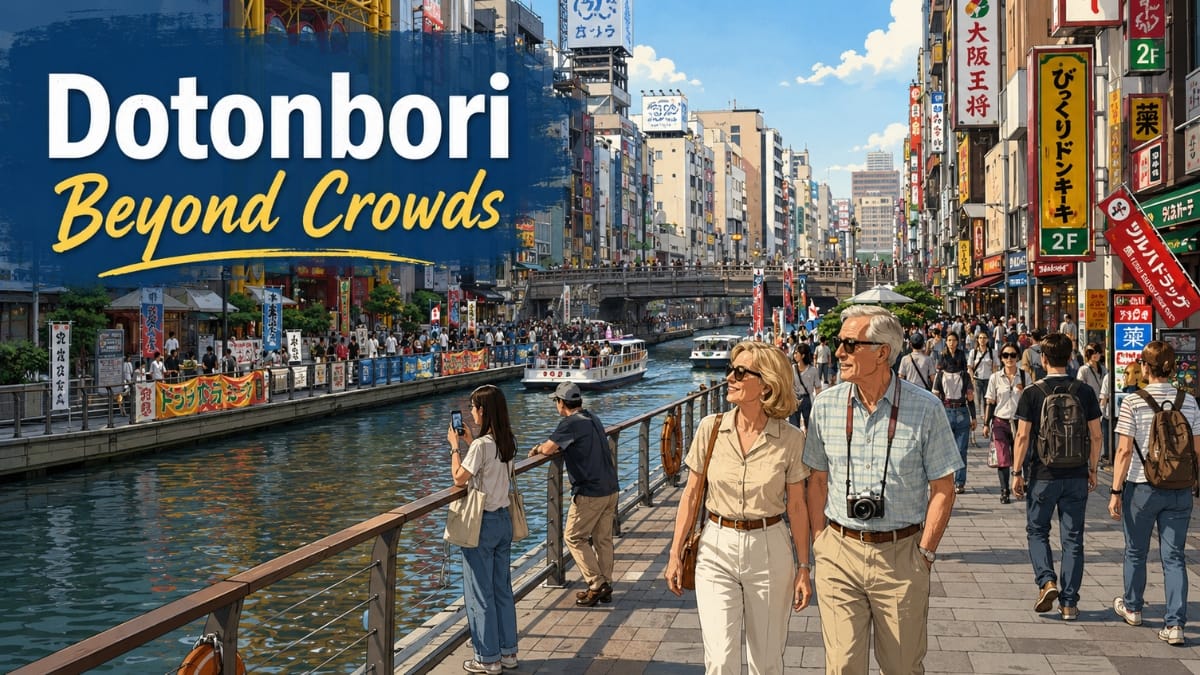
The giant signs around Ebisu Bridge are only one small part of Dotonbori. If you want to know how to explore Dotonbori beyond crowds, step away from the bridge, use the canal as your guide, and give the neighborhood time outside its busiest evening hours. You will find narrow lanes, small temples, quieter river views, and places to eat that feel less like a photo stop.
Dotonbori is in central Osaka, between Namba and Shinsaibashi. It is easy to reach, but it is also one of the city’s most concentrated visitor areas. The goal is not to avoid people completely. It is to see the famous area efficiently, then spend the rest of your time in the streets that reveal more of the neighborhood.
Start with the right expectations
Dotonbori is a commercial entertainment district, not a quiet historic quarter. Bright signs, restaurant calls, lines, music, delivery bicycles, and dense pedestrian traffic are normal, especially after sunset. The main route between Ebisu Bridge and the canal-side restaurants can feel crowded even on a weekday.
For first-time visitors, the easiest access points are Namba Station on the Osaka Metro Midosuji Line, Namba Station on the Nankai Railway, or Nippombashi Station on the Osaka Metro Sakaisuji and Sennichimae lines. From any of these stations, Dotonbori is generally a short walk, although Namba Station is large and has several rail operators. Follow signs for Dotonbori or exit toward the pedestrian shopping streets, then check your map once you are above ground.
Plan about two to three hours if you want to walk, eat, and visit a few side streets. One hour is enough for the main signs and canal, but it will not give you much time away from the busiest areas.
How to explore Dotonbori beyond crowds: use timing first
The most useful decision is when you arrive. The area is usually easier to walk through before late morning, when many restaurants are preparing for lunch and the evening crowd has not begun. Around 9:00 to 10:30 a.m., the famous sign area is still active, but you can take photos and orient yourself without moving in a slow crowd.
Early afternoon can also work if you are mainly visiting Hozenji Yokocho, the river walk, or nearby covered shopping streets. The busiest period is commonly from around 6:00 p.m. through late evening, particularly on weekends, holidays, and during school vacation periods. At that time, do not try to make Dotonbori your only dinner plan unless you are comfortable waiting in line.
Night has a trade-off. The lights reflected on the canal are part of the appeal, but the streets are at their fullest. A practical approach is to visit once in the morning for relaxed walking, then return briefly after dark for the atmosphere. You do not need to spend the entire evening at Ebisu Bridge.
Rainy weather can reduce outdoor crowds, but the covered arcades nearby become busier. Bring an umbrella that closes neatly and avoid stopping in the middle of narrow walkways.
Walk the canal, not only the main street
After seeing the Glico sign and Ebisu Bridge, take the stairs down to the Dotonbori River Walk. The promenade runs alongside the canal and gives you more space than the street above. It is useful for looking at the restaurant facades without blocking other pedestrians, and it offers a calmer view of the district’s signs.
Walk west from Ebisu Bridge for a less hectic stretch toward Daikoku Bridge. The neon becomes less concentrated, and you can see how quickly Dotonbori changes once you leave its best-known center. This is a good route before dinner or when you need a break from the shopping streets.
Walking east toward Nippombashi gives you another perspective, although parts of the route can still be busy. Continue at an unhurried pace and use the bridges as landmarks. You do not need to follow the canal continuously. The value is in moving between the river, the main road, and the smaller lanes rather than staying in one packed corridor.
A river cruise can be enjoyable if you want to sit down and see the signs from the water. It is not the best choice for avoiding crowds, since boarding areas and popular time slots can be busy. Treat it as a short sightseeing activity, not a quiet escape. Check the day’s operating conditions and ticket process before building your schedule around it.
Make time for Hozenji Yokocho and Hozenji Temple
A few minutes south of the main Dotonbori strip, Hozenji Yokocho is one of the clearest changes of pace in the area. This short stone-paved lane has traditional-style restaurant fronts and lanterns. It is compact, so it can still feel busy, but it is far less visually overwhelming than the large signs along the canal.
At its center is Hozenji Temple and the moss-covered Mizukake Fudo statue. Visitors often pour water over the statue as part of a prayer practice. If you participate, watch what others do, follow any posted instructions, and keep the space clear for people who are praying. This is a religious site, not a backdrop for loud group photos.
The lane is especially attractive in the evening, but it is also one of the places where an early visit helps. Some restaurants here are small and may require reservations, have limited seating, or operate with specific meal hours. Do not assume that every traditional-looking entrance accepts walk-ins.
Choose food with a plan, not from the longest line
Dotonbori is known for takoyaki, okonomiyaki, kushikatsu, ramen, grilled seafood, and casual snacks. The challenge is not finding food. It is choosing without spending most of your evening in a queue.
For a full meal, arrive before the usual dinner rush, usually around 5:00 p.m., or eat later after 8:30 p.m. Hours vary by restaurant, and some popular places stop accepting new guests before closing time. If you have a specific restaurant in mind, check whether it takes reservations and whether it has rules for group size.
For street food, eat before you start walking again. Dotonbori’s sidewalks are narrow, and stopping suddenly with hot food creates congestion. Use designated standing areas when available and dispose of trash in the store’s bin if instructed. Public trash cans can be limited, so carrying a small bag for wrappers is sensible.
Cash is still useful for smaller food counters, although many restaurants accept cards and IC cards. Do not rely on one payment method. If you use an IC card for trains, it may work at some shops but not all of them.
Use the surrounding streets to reset your walk
Dotonbori connects easily to several nearby areas, each with a different feel. North of the canal, Shinsaibashi-suji is a long covered shopping arcade. It is convenient in bad weather and useful for practical shopping, but it can be just as crowded as Dotonbori during peak hours.
For a more relaxed walk, head west toward Horie. The transition is gradual, with smaller boutiques, cafes, and residential side streets. It is a better choice if you want to sit down for coffee or browse without the constant pressure of large crowds. From the western side of Dotonbori, the walk is manageable, but allow extra time if you are traveling with young children or luggage.
East of Dotonbori, the streets toward Nippombashi become more focused on electronics, hobby shops, and casual local businesses. This direction suits travelers who want to continue toward Kuromon Market or the Den Den Town area, although Kuromon itself can be busy around lunchtime.
South of the canal, the lanes around Sennichimae can be useful for restaurants and entertainment. They are not necessarily quiet at night, but they offer alternatives to the single crowded Dotonbori route. Keep your bearings, especially after dark, and avoid following restaurant solicitors into places you have not independently chosen.
Avoid the mistakes that make Dotonbori stressful
The most common mistake is arriving hungry at 7:00 p.m. on a Saturday and expecting a quick dinner. Another is treating Ebisu Bridge as the entire neighborhood. See it, take your photo, then move on before the crowd turns a short stop into an exhausting one.
Stay to the side when checking directions or taking photos. Do not stop at the top or bottom of stairs, in storefront entrances, or in the middle of a bridge. If you are meeting someone, choose a clear landmark away from the bridge itself.
Dotonbori is generally easy to navigate, but it is easy to lose track of direction in the covered arcades and narrow lanes. Save your hotel location before you go, carry a charged phone, and remember whether you need to return to Namba, Shinsaibashi, or Nippombashi Station. These stations are close on a map but can require different walking routes and train lines.
For a better Dotonbori visit, let the famous signs be the beginning rather than the whole plan. A morning canal walk, a respectful stop at Hozenji, and one deliberate meal will show you a more comfortable side of one of Osaka’s busiest neighborhoods.