
Osaka is often added to a Japan itinerary for food, nightlife, or a quick stop before Kyoto. But is Osaka worth visiting if you have limited time? For most first-time visitors, yes – especially if you want a city that is easier to navigate than Tokyo, more relaxed than Kyoto, and full of useful places to eat, shop, and spend an evening.
The important question is not whether Osaka has enough attractions. It does. The better question is whether its style suits your trip. Osaka works best for travelers who enjoy neighborhoods, casual dining, urban energy, and day trips. It can feel less suitable if your priority is quiet temples, traditional streets, or major museums every day.
Is Osaka Worth Visiting for a First Japan Trip?
Osaka is a practical choice for a first visit to Japan because it is well connected, compact by big-city standards, and easy to use as a base. Two main areas, Umeda in the north and Namba in the south, cover many hotel, dining, shopping, and rail needs. You do not need to understand the entire city before arriving.
Kansai International Airport has direct rail access to central Osaka, while Shin-Osaka Station connects the city to the Shinkansen network. This makes Osaka particularly convenient if you are arriving from Tokyo or continuing to Hiroshima. An IC card is useful on most local trains, subways, and buses, and station signs usually include English.
Osaka also gives first-time visitors a lower-pressure introduction to Japanese city travel. Major stations are busy, and Umeda can be confusing at first, but the city is not spread across as many separate tourist districts as Tokyo. Once you understand where you are staying, daily travel is usually straightforward.
That said, Osaka is not a replacement for Kyoto. It has temples, shrines, gardens, and Osaka Castle, but its appeal is more modern and everyday. Come to Osaka for the streets, food culture, entertainment districts, and convenient access to the wider Kansai region. Treat historic sights as part of the trip, not the whole reason for it.
What Osaka Does Better Than Other Japanese Cities
Osaka is strongest when you plan around how people actually use the city. You can spend the morning at Osaka Castle Park, eat lunch near Namba, walk through Dotonbori after dark, and still return to your hotel without a complicated journey. The city rewards flexible plans rather than a strict attraction-by-attraction schedule.
Food is one of the clearest reasons to visit. You will find takoyaki, okonomiyaki, kushikatsu, ramen, sushi, coffee shops, department store food halls, and small counter restaurants across the city. The advantage is not that every restaurant is exceptional. It is that good, reasonably priced choices are everywhere, including near major stations.
For evening activity, Namba, Dotonbori, Shinsaibashi, and nearby Amerikamura create a concentrated area for walking, eating, shopping, and people-watching. Dotonbori is crowded and commercial, particularly after sunset. It is worth seeing once, but it should not be your only impression of Osaka. A short walk away, Hozenji Yokocho has a quieter atmosphere, while Nakazakicho near Umeda offers older streets and independent cafes.
Osaka is also a strong base for day trips. Kyoto, Nara, Kobe, Himeji, and Universal Studios Japan are all realistic additions depending on your schedule. This is useful when you prefer one hotel instead of moving luggage every one or two nights. Check which station serves your destination before choosing a hotel: Osaka Station and Umeda are convenient for Kyoto and Kobe, while Namba is often easier for Nara and Kansai Airport services.
The Trade-Offs: When Osaka May Not Be Your Best Choice
Osaka can feel noisy, dense, and visually busy. Around Namba and Umeda, elevated roads, large signs, crowds, and station malls are part of the landscape. If you want a calm stay with early nights, avoid booking directly beside Dotonbori or the busiest stretches of Shinsaibashi.
The city’s famous food areas also create a common mistake: travelers spend too much time standing in long lines for a few well-known shops. A restaurant with a short menu, a queue, and social media attention is not automatically better than a small place one street away. Eat at peak times only if you are comfortable waiting. Otherwise, go early, go later, or choose a quieter neighborhood.
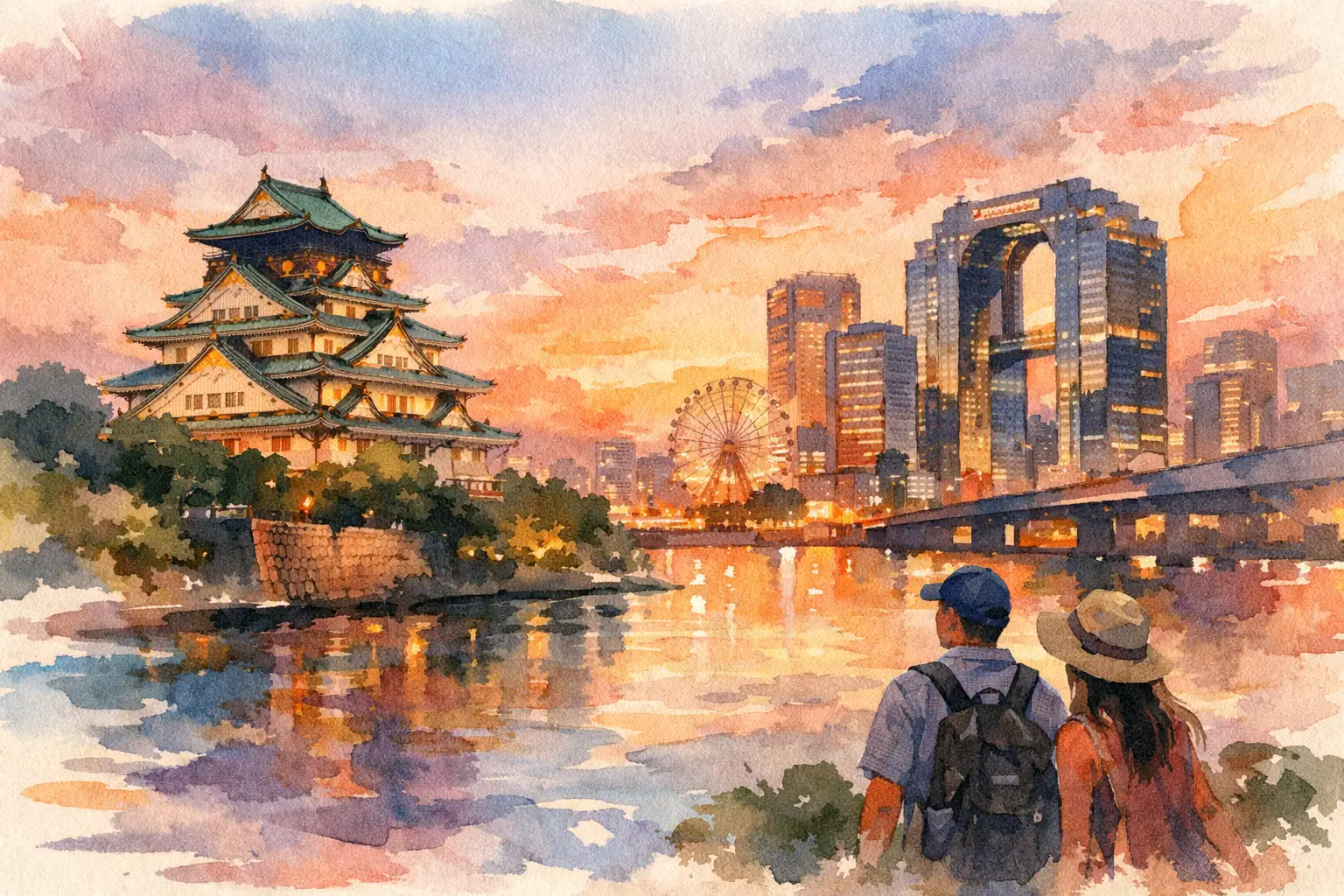
Osaka Castle is another place to set expectations carefully. The park is pleasant and especially popular during cherry blossom season, but the current castle interior is a museum rather than an original palace interior. It is worth visiting if you want city views, the grounds, and historical context. Travelers looking for preserved old streets and temple landscapes may find Kyoto more satisfying.
If your Japan trip is only four or five nights and you are already staying in Tokyo and Kyoto, adding Osaka can mean another hotel change without enough time to enjoy it. In that case, an evening visit from Kyoto is possible, though it is not the same as staying overnight. Osaka becomes more worthwhile when you can give it at least two nights or use it as your Kansai base.
How Long to Stay in Osaka
Two nights is the minimum that feels useful. It gives you one arrival or departure day, one full day for central Osaka, and an evening in Namba or Umeda. This works well for travelers who mainly want to see Osaka Castle, Dotonbori, Kuromon Market, Shinsekai, and a few food stops.
Three nights is more comfortable. You can explore at a slower pace, visit a neighborhood beyond the central highlights, and take a day trip without making the stay feel rushed. Families often benefit from three nights if they plan a full day at Universal Studios Japan, since travel, entry lines, meals, and breaks can take longer than expected.
Four or more nights makes sense when Osaka is your base for Kyoto, Nara, Kobe, or Himeji. It is not necessary to see every part of Osaka itself. Instead, use the extra time to avoid packing every morning and to return to the city for dinner and rest.
Where to Stay So Osaka Feels Easy
For most first-time visitors, Umeda and Namba are the safest choices. Umeda is centered on Osaka Station and several connected rail and subway stations. It is useful for Shinkansen connections via Shin-Osaka, trips to Kyoto or Kobe, department stores, and a broad range of hotels. The downside is the station complex. Allow extra time during your first visit, especially when finding the correct exit.
Namba is better if you want to walk to Dotonbori, Shinsaibashi, Kuromon Market, and many late-night dining options. It has multiple rail stations with similar names, so confirm the exact station used by your hotel. Namba is lively, which is convenient for some travelers and tiring for others.
For a quieter stay, consider areas just outside these centers, such as Yodoyabashi, Honmachi, or Tennoji. You may give up immediate access to the busiest sights, but you can still reach them quickly by subway. Check the walking route from the nearest station, not just the name of the neighborhood. A hotel described as being near Osaka Station can still involve a long underground walk.
Practical Things That Make a Difference
Use an IC card for local transport and keep some cash for small restaurants, market stalls, temple donations, and coin lockers. Credit cards are common in larger stores and hotels, but payment options vary at independent businesses. Carrying a small amount of cash removes unnecessary stress.
Plan popular places around crowd patterns. Dotonbori is easiest to photograph in the morning and most energetic after dark. Kuromon Market is better earlier in the day, before some stalls sell out or close. Universal Studios Japan needs advance planning, particularly on weekends, school vacations, and holiday periods. For restaurants that take reservations, book ahead if you have a specific place in mind.
Summer in Osaka is hot and humid, and long outdoor walks can become tiring. Build in indoor stops at department stores, cafes, museums, or underground shopping areas. In winter, the city is easier for walking but evenings can feel cold near the river and open streets. Spring and fall are pleasant but bring heavier crowds around weekends and seasonal events.
Who Will Get the Most From Osaka?
Osaka is especially good for couples, friends, solo travelers, and families who want variety without complex logistics. It suits people who like trying several foods in one day, exploring after dinner, and using trains to reach nearby cities. It is also useful for travelers who do not want every part of their Japan trip to feel formal or scheduled.
You may enjoy Osaka less if you strongly prefer quiet rural scenery, traditional architecture, or a trip built around famous temples. Even then, it can still work as a convenient two-night stop or transport base. Choose your neighborhood carefully, keep your sightseeing expectations realistic, and let Osaka be what it is: a large, useful, energetic city with plenty to do between the headline attractions.
If your itinerary has room for two or three nights, Osaka is usually worth visiting. Give it enough time to eat well, get slightly beyond Dotonbori, and experience the city after the day-trip crowds have left.