
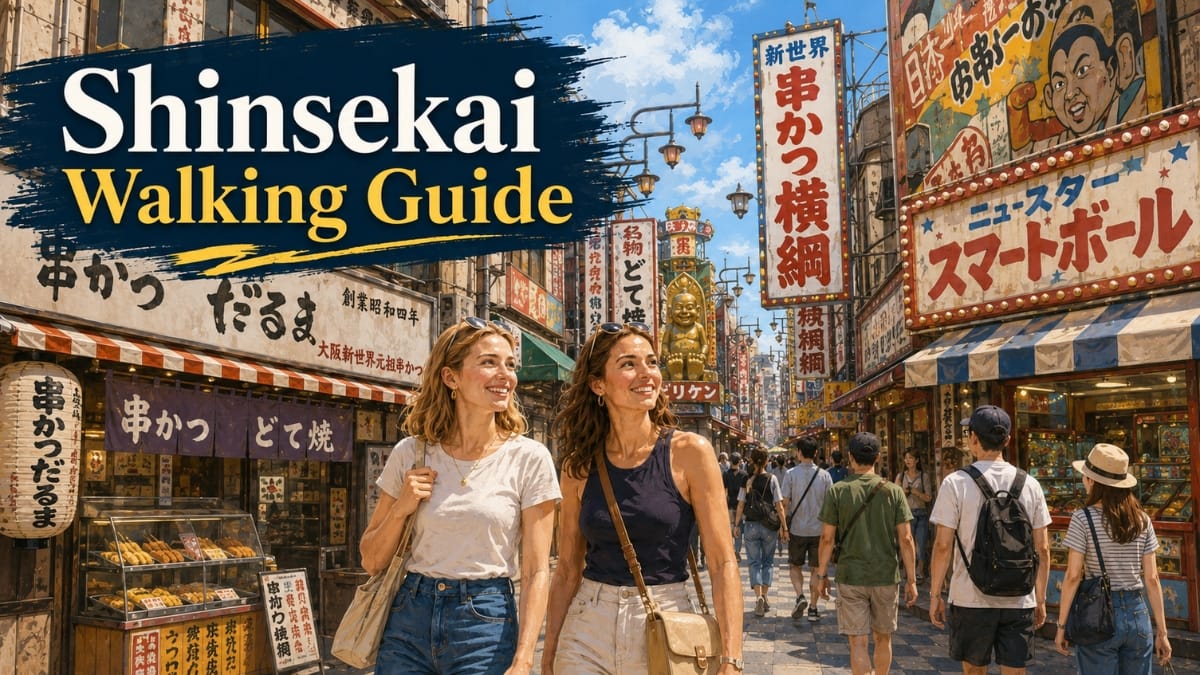
Few Osaka neighborhoods change mood as quickly as Shinsekai. One minute you are under the Tsutenkaku Tower looking at bright signs and retro storefronts. A few blocks later, the streets feel quieter, older, and more local. This shinsekai walking guide is designed for first-time visitors who want to see the area clearly, move around without stress, and avoid the usual confusion about what Shinsekai actually is.
What Shinsekai is and why people visit
Shinsekai is a historic entertainment district in southern Osaka, near Tennoji. It is best known for Tsutenkaku, kushikatsu restaurants, old-school game arcades, and streets with a worn but memorable atmosphere. It does not feel polished in the same way as Umeda or the newer parts of Namba. That difference is exactly why many travelers want to walk here.
For most visitors, Shinsekai works best as a short neighborhood walk rather than a full-day stop. You come to see the tower area, eat something classic, take photos of the street scenery, and get a sense of an older side of Osaka. If you try to treat it like a large sightseeing district with nonstop attractions, it can feel smaller than expected.
How to get to Shinsekai
The easiest station for most travelers is Dobutsuen-mae Station on the Osaka Metro Midosuji Line or Sakaisuji Line. From there, it is a short walk into the heart of Shinsekai. Shin-Imamiya Station is also convenient if you are using JR or Nankai trains. Ebisucho Station works well too, especially if you want to enter from the north side near Tsutenkaku.
For first-time visitors, Dobutsuen-mae is often the simplest choice if you are already staying in Namba, Shinsaibashi, or Umeda. The ride is straightforward, and IC cards make the trip easy. Station areas around Shinsekai can feel a little rougher and less polished than central tourist zones, but the route is still manageable for most travelers in the daytime.
If you are carrying large luggage, this is not the best neighborhood to explore immediately after check-in or before a train transfer. Streets are better for walking light, stopping often, and moving at a slow pace.
How long you need for a Shinsekai walking guide route
Most travelers need 1.5 to 3 hours in Shinsekai. If you plan to go up Tsutenkaku, eat a relaxed meal, and take plenty of photos, allow closer to 3 hours. If you only want a quick walk and a snack, 60 to 90 minutes is enough.
Late morning to early evening is usually the easiest time for a first visit. The area is lively, restaurants are open, and navigation is simpler in daylight. Night has more atmosphere, but it also feels busier, louder, and less comfortable for some travelers, especially families with small children or people who prefer calmer neighborhoods.
A simple Shinsekai walking guide route
Start near Tsutenkaku. This is the visual center of Shinsekai and the easiest landmark to orient yourself around. Once you are under the tower, the neighborhood makes more sense. You will see the classic signboards, kushikatsu restaurants, souvenir shops, and the retro streets most visitors came to find.
From there, walk through the main restaurant streets around the tower. This is the best section for first-time visitors because the atmosphere is concentrated and easy to read. If you arrive before lunch, the area can feel more relaxed. Around lunch and dinner, it gets more crowded and more photo-heavy.
After the central streets, continue south or west for a few blocks rather than turning back immediately. This gives you a better sense of how Shinsekai changes outside the main tourist strip. The neighborhood becomes less colorful and more residential-looking, with older buildings and everyday local life. That contrast is part of the appeal, but it also means some visitors find the outer edges less comfortable.
If you want to extend the walk, the area connects naturally with Tennoji Zoo, Spa World, and the Tennoji area more broadly. If your goal is only Shinsekai itself, though, there is no need to force a long route. A shorter walk is often more satisfying here.
What to eat in Shinsekai
The food most strongly associated with Shinsekai is kushikatsu, which is deep-fried skewered meat, seafood, and vegetables. Many restaurants in the area specialize in it. For first-time visitors, this is the most obvious meal choice and usually the easiest one to understand from menus, signs, or display models.
A common rule to know before you sit down is that dipping sauce is usually shared, and double-dipping is not allowed. If you need more sauce, use the provided cabbage to scoop it. Even if a restaurant has multilingual support, this rule is so well known in Osaka that it helps to understand it in advance.
You will also find casual snacks, drinks, and older-style eateries around the district. The quality can vary. Shinsekai is more about atmosphere and classic Osaka comfort food than carefully curated dining. If you want a highly polished meal, you may prefer Tennoji, Namba, or Umeda. If you want something informal and very local in feel, Shinsekai makes more sense.
What to expect from the atmosphere
This is not a clean, quiet, design-focused neighborhood. It is colorful, nostalgic, a little chaotic, and visibly aged. That is part of its identity. Some travelers love it immediately. Others feel unsure because it does not look like the Osaka they expected from Dotonbori or Osaka Station.
The area is generally straightforward to visit, but it helps to set expectations correctly. Shinsekai can feel gritty in places. Some streets are smoking-heavy. Some businesses are aimed more at adult visitors than families. The neighborhood is still popular with tourists, but it does not present itself in a polished way.
That does not mean you should avoid it. It means Shinsekai is best enjoyed as a specific kind of Osaka walk. Come for street atmosphere, retro scenery, casual food, and a short wander. Do not come expecting a refined shopping district or a deeply traditional historic quarter.
Common mistakes to avoid in Shinsekai
The most common mistake is arriving with the wrong expectation. Shinsekai is famous, but it is not large. If you expect hours of sightseeing variety, you may be disappointed. Pairing it with Tennoji, Abeno, or a nearby attraction usually makes for a better half-day.
Another mistake is going only for social media photos and skipping the actual neighborhood walk. The tower area is photogenic, but the feeling of Shinsekai comes from walking slowly through a few surrounding blocks, not just taking one picture and leaving.
Some travelers also choose the busiest meal times and then feel rushed by lines and crowds. If you want a more relaxed meal, go a little earlier for lunch or a little earlier for dinner. It makes a noticeable difference.
Finally, be careful late at night if you are unfamiliar with the area. Shinsekai is a real city neighborhood, not a themed attraction. Daytime and early evening are the easiest windows for first-time visitors.
Is Shinsekai good for families, couples, or solo travelers?
It depends on your travel style. Couples and solo travelers usually find Shinsekai easy to add to an Osaka itinerary, especially if they enjoy street photography, casual eating, or neighborhoods with a rougher edge. Families can still visit, but the fit is more mixed. If children want bright streets, snack foods, and a tower view, it can be fun. If you want clean open space and a calm pace, nearby Tennoji Park may be easier.
For older travelers or anyone sensitive to smoke, noise, or uneven streets, a shorter daytime visit is often the best plan. For visitors who like older urban neighborhoods with character, Shinsekai can be one of the more memorable walks in Osaka.
Practical tips before you go
Cashless payment is common in Osaka now, but small restaurants and older businesses may still be more comfortable with cash, so carrying some yen is a good idea. IC cards are the easiest way to reach the area by train or subway. English support varies. Around the main tourist streets, you will usually find enough signs, food models, or simple menus to get by.
Wear comfortable shoes. This is a neighborhood for wandering, not a single indoor attraction. If the weather is very hot or rainy, Shinsekai becomes less pleasant because much of the experience is outdoors. In summer, aim for morning or late afternoon and take breaks.
If you only have one short opening in your Osaka schedule, Shinsekai is worth choosing when you want a more old-school city atmosphere than Dotonbori or Umeda can offer. Keep the visit short, stay aware of your surroundings, and let the area be what it is rather than what the photos promised. That approach usually leads to the best walk.