
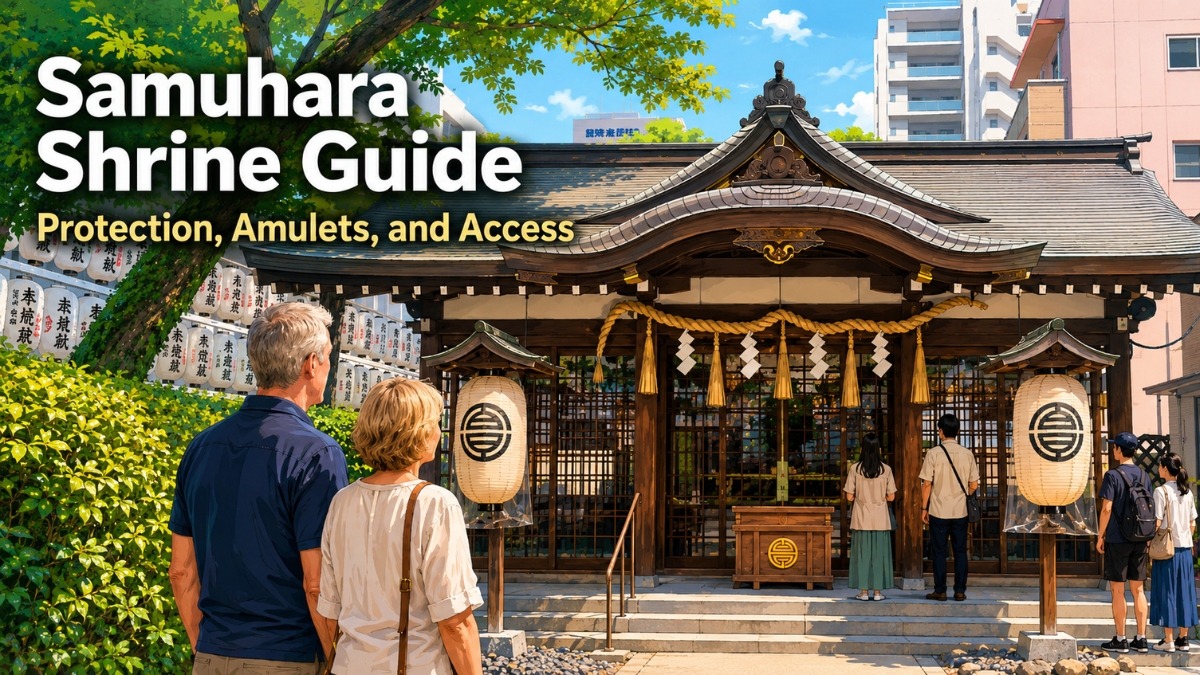
Samuhara Shrine is a small Shinto shrine in Osaka’s Nishi Ward, near Awaza. It is known for prayers related to protection from misfortune, safety, good health, and its rare ring-shaped amulet called Goshinkan.
Some Japanese visitors describe Samuhara Shrine as “intense,” “mysterious,” or even “a little scary.” For first-time visitors from overseas, this does not mean the shrine is dangerous. It usually means the shrine has a serious atmosphere, strong protective symbolism, and a style of worship that feels different from casual sightseeing shrines.
This guide explains what Samuhara Shrine is, why people visit, what its blessings mean in Japanese shrine culture, how to visit respectfully, and what to know before looking for the famous ring amulet.
Before You Visit: What Kind of Shrine Is Samuhara Shrine?
Samuhara Shrine is located at 2-5-26 Itachibori, Nishi-ku, Osaka, in a business district west of central Umeda and south of Awaza. The nearest station is Awaza Station on the Osaka Metro Chuo Line, about a 6-minute walk away. Nishi-Ohashi Station on the Nagahori Tsurumi-ryokuchi Line is about an 8-minute walk away.
The shrine enshrines three deities known as the Zōka Sanshin, or the Three Deities of Creation: Amenominakanushi Ōkami, Takamimusubi Ōkami, and Kamimusubi Ōkami. In Japanese mythology, these deities are connected with creation, life, and the origin of things.
For visitors unfamiliar with Shinto, a shrine is not mainly a place to “get a wish.” It is a sacred place where people give thanks, pray, ask for protection, and reflect on their lives. At Samuhara Shrine, the focus is especially on protection, avoiding misfortune, and praying for safety.
Normal worship is open to visitors, and the shrine states that people may visit freely and peacefully. Formal prayers, however, require advance contact and are not accepted every day.
Why Some Visitors Say Samuhara Shrine Feels “Scary”
The Atmosphere Is Serious, Not Tourist-Like
Samuhara Shrine is not a large sightseeing shrine with souvenir streets, photo spots, and crowds of casual tourists. It is compact, quiet, and located in an urban business district.
That can surprise first-time visitors. The shrine feels less like a tourist attraction and more like a place where people come with serious prayers.
For overseas visitors, it is better to understand the “scary” feeling as a sense of awe. In Japanese, this is close to osore, meaning respectful fear or reverence toward something sacred. It is not horror. It is the feeling that you should behave carefully.
The Deities Are Connected With Creation and Protection
The shrine’s deities are not local mascot-like figures. They are ancient creation deities with a high position in Japanese mythology. The shrine explains “Samuhara” as connected with these three deities and their life-giving, protective power.
This is one reason the shrine can feel spiritually “strong” to visitors. Many people do not come here for light wishes. They come to pray for safety, health, protection from danger, or support during difficult times.
A good mindset is simple:
“I am grateful to be here. Please help me stay safe and live well.”
That is more appropriate than treating the shrine as a place to demand quick results.
The Sacred Characters Look Unusual
The word Samuhara is often associated with special sacred characters. The shrine explains that these characters have long been transmitted as protective symbols used to ward off disasters, protect the body, avoid injury, and pray for safety. They were also used historically as protective talismans.
For foreign visitors, these characters may look mysterious because they are not normal everyday Japanese writing. They can feel like a symbol or seal rather than ordinary text.
This visual power is part of the shrine’s identity. It is not meant to frighten visitors. It represents protection.
What “Blessings” Mean at Samuhara Shrine
Protection Is the Main Theme
Samuhara Shrine is associated with blessings such as protection from misfortune, safety from injury, good health, long life, safe travel, traffic safety, family safety, and avoiding bad luck. The shrine’s formal prayer categories include items such as health, traffic safety, safe travel, recovery from illness, protection from misfortune, and safety.
In English, these are often called blessings or benefits, but that can be misleading.
A blessing at a shrine is not a guaranteed result. It is a religious and cultural form of prayer. People visit, give thanks, ask for protection, and try to live more carefully afterward.
Do not write or think, “This shrine prevents all accidents.”
A better way to understand it is:
“People traditionally visit this shrine to pray for protection from misfortune and harm.”
Do Not Treat the Shrine as a Medical or Safety Guarantee
Some visitors pray for health or recovery from illness. That is common in Japanese shrine culture. However, shrine prayer should never replace medical care, professional advice, safety precautions, insurance, or common sense.
If you are ill, see a doctor.
If you are driving, drive carefully.
If you are traveling, plan responsibly.
The shrine can support your mind and intention. It does not remove the need for practical action.
The Famous Ring Amulet: Goshinkan
What the Ring Amulet Is
Samuhara Shrine became especially well known because of its ring-shaped amulet, called Goshinkan. It is treated as a sign of divine protection, not as a fashion item or souvenir. The shrine clearly states that the amulet is a proof of divine protection and not a commemorative item.
This is important for foreign visitors. The ring is not a collectible accessory. It belongs to the religious culture of the shrine.
Current Status of the Ring Amulet
As of the shrine’s current official notice, applications for the Goshinkan ring amulet have been temporarily closed since the end of November 2025. The shrine also notes that production takes a long time.
This means you should not visit Samuhara Shrine expecting to receive the ring on the spot.
The shrine’s official information also says applications from people without an address in Japan cannot be accepted.
For most overseas travelers, the best advice is clear: visit the shrine to pray, not to chase the ring.
Other Amulets Are Available
Samuhara Shrine also offers other amulets and sacred items, including coin-shaped body amulets, traffic safety amulets, household safety talismans, protection talismans, and more. The shrine’s official list includes several items with stated offerings, such as the coin-shaped Zenigata Hada-mamori and traffic safety amulet.
If you want an amulet, ask politely at the shrine office. Bring cash. Do not assume English support will always be available.
Helpful links:
Official site: Samuhara Shrine
Amulets and prayers: Samuhara Shrine Worship, Prayer, and Gifts
Goshinkan ring amulet: Samuhara Shrine Ring Amulet
Google Maps: Samuhara Shrine on Google Maps
Why You Should Avoid Resold Amulets
You may see Samuhara amulets, especially ring amulets, sold online at high prices. Avoid them.
In Japanese shrine culture, an amulet is normally received through a direct relationship with the shrine. Buying a resold amulet from a marketplace changes the meaning. It turns a sacred item into a commercial object.
If the ring is not available, accept that. You can still pray at the shrine. You can still receive other amulets if available. You can still give thanks.
Do not let the search for a rare object become the main purpose of the visit.
“Only People Called by the Deity Can Visit”: How to Understand This Idea
Treat It as a Cultural Saying, Not a Rule
Some people say, “You can only visit Samuhara Shrine if you are called.” You may also hear stories about people getting lost, plans changing, or feeling suddenly unable to go.
For first-time visitors, do not take this as a literal rule. You do not need a supernatural invitation to visit.
A more balanced way to understand the idea is this: Samuhara Shrine is a serious place, and people often visit when they feel ready to reflect, pray, or reset their mind.
If your schedule changes or you cannot visit, do not force it. Go another day.
Feeling Nervous Does Not Mean You Are Rejected
Some visitors feel tense at powerful or unfamiliar shrines. This can happen because the place is quiet, the rituals are unfamiliar, or you are not used to Shinto spaces.
Take a breath before entering. Bow lightly at the torii gate. Walk slowly. Keep your phone away for a moment.
You do not need to feel anything dramatic. A respectful, simple visit is enough.
How to Pray at Samuhara Shrine
Basic Shrine Etiquette
At a Shinto shrine, the usual worship method is simple:
- Bow lightly before entering the shrine grounds.
- Walk calmly and avoid the center of the approach when possible.
- At the worship hall, place a small coin in the offering box.
- Bow deeply twice.
- Clap twice.
- Pray quietly.
- Bow deeply once.
If other local worshippers do something slightly different, do not worry. Quiet respect matters more than perfect form.
What to Pray For
Samuhara Shrine is especially connected with protection and safety. Suitable prayers include:
- Safe travel
- Protection from accidents
- Good health
- Recovery and strength
- Family safety
- Avoiding misfortune
- Gratitude for being safe today
A respectful prayer may sound like this:
“Thank you for protecting me. Please help me travel safely and live with care.”
This kind of prayer fits the shrine’s atmosphere better than a long list of demands.
Formal Prayers and Shrine Office
Samuhara Shrine accepts various formal prayers, including prayers for family safety, traffic safety, safe travel, good health, recovery from illness, business prosperity, childbirth safety, and more. The shrine states that formal prayers are not accepted on Wednesdays and that visitors should contact the shrine in advance for prayer requests.
For most overseas travelers, normal worship is enough. If you want a formal prayer, contact the shrine before visiting and do not assume same-day English support.
Location: 2-5-26 Itachibori, Nishi-ku, Osaka
Nearest station: Awaza Station
Normal worship: Visitors may pray freely
Formal prayer: Contact the shrine in advance
Closed for formal prayers: Wednesdays, according to the shrine’s guidance
Cost: Normal worship is free, but offerings, amulets, and formal prayers require separate offerings
Access to Samuhara Shrine
From Central Osaka
Samuhara Shrine is easy to reach by Osaka Metro. The official site lists Awaza Station on the Chuo Line as about a 6-minute walk and Nishi-Ohashi Station on the Nagahori Tsurumi-ryokuchi Line as about an 8-minute walk.
From Umeda, Namba, or Honmachi, use Osaka Metro and check the best route on the day. The area is urban and walkable, but the shrine is small, so it is easy to pass if you are not paying attention.
Address: 2-5-26 Itachibori, Nishi-ku, Osaka
Nearest station: Awaza Station
Walking time: About 6 minutes from Awaza Station
Alternative station: Nishi-Ohashi Station, about 8 minutes on foot
IC card: Osaka Metro accepts major IC cards such as ICOCA and Suica
Best time: Morning or daytime if this is your first visit
Reservation: Not needed for normal worship
Helpful links:
Official site: Samuhara Shrine
Google Maps: Samuhara Shrine on Google Maps
Visiting With Respect in an Urban Setting
Samuhara Shrine is located in a working city area, not in a remote forest. People live, work, and move around the neighborhood.
Be careful not to block roads, stand in front of nearby buildings, or take photos of unrelated facilities. Do not photograph people without permission. If security or staff ask you to move, follow their instructions calmly.
The shrine is small. Speak quietly, avoid long photo sessions, and do not treat the site as a dramatic “scary power spot.”
Samuhara Shrine Okunomiya in Okayama
The Root Site in Tsuyama
Samuhara Shrine also has an Okunomiya, or inner shrine, in Tsuyama City, Okayama Prefecture. The Osaka shrine’s official site lists the Okunomiya address as 900-3 Nakahara, Kamo-cho, Tsuyama, Okayama, and warns that some online address searches may incorrectly lead to Tsugawa Dam. It recommends using the nearby Konpira Shrine address if navigation does not work correctly.
The Tsuyama site is the root connected with the Osaka shrine and notes that it is in the Kamo area of Tsuyama.
This is not a casual side trip from Osaka. It is far from the city and better suited for people with a car and a specific reason to visit.
What to Know Before Going to Okunomiya
The Osaka shrine’s official site says the Okunomiya is far from the nearest station and that visiting by car is better. It also notes that no priest is stationed there.
For foreign travelers, this is important. Do not go there late in the day, in poor weather, or without checking your transport. Rural shrine visits require more preparation than urban shrine visits.
Helpful links:
Official information: Samuhara Shrine Okunomiya Access
Google Maps: Samuhara Shrine Okunomiya on Google Maps
What to Do After Visiting Samuhara Shrine
Take Time to Reset
Because Samuhara Shrine has a serious atmosphere, it can be helpful to take a quiet break afterward. Do not immediately rush into a crowded shopping area if you feel mentally full.
Awaza, Nishi-Nagahori, and nearby Nishi-ku have quieter cafés than Umeda or Namba. A short café break after visiting can help you return to the normal rhythm of the city.
Consider Walking to Utsubo Park
If the weather is good, Utsubo Park is a practical place to walk after the shrine. It is not directly next door, but it is within the broader Nishi-ku area and gives you greenery, open space, and a calmer feeling than the surrounding streets.
This is a good option if you want to process the visit slowly before returning to sightseeing.
Google Maps: Utsubo Park on Google Maps
Common Mistakes to Avoid
Mistake 1: Calling It a Temple
Samuhara Shrine is a Shinto shrine, not a Buddhist temple. Use “shrine” in English.
You will see shrine customs such as torii gates, offerings, clapping during prayer, and Shinto amulets.
Mistake 2: Treating the Shrine as a Horror Spot
Some people describe the shrine as intense or mysterious, but it is not a haunted attraction. It is a place of worship.
Do not visit only to test whether something strange will happen. Visit with respect.
Mistake 3: Expecting to Receive the Ring Amulet
The famous Goshinkan ring amulet is not currently something most travelers can simply receive at the counter. Applications have been temporarily closed since the end of November 2025, and the shrine states that applicants without an address in Japan cannot be accepted.
Do not plan your visit only around the ring.
Mistake 4: Buying Resold Amulets Online
Avoid resold amulets. If you want a Samuhara amulet, receive one properly through the shrine when available.
A shrine amulet is not just a product.
Mistake 5: Making Unsafe Claims About Blessings
Do not say, “This shrine will stop accidents” or “This amulet guarantees protection.” A more accurate phrase is:
“Samuhara Shrine is traditionally visited by people praying for protection from misfortune and harm.”
This respects the belief without making false promises.
Mistake 6: Ignoring the Neighborhood
The shrine is in a real city neighborhood. Do not block sidewalks, photograph unrelated buildings, park illegally, or make noise.
Good manners are part of the prayer.
Local Tips for First-Time Visitors
Visit During the Day
For a first visit, go during daylight. It is easier to find the shrine, read signs, and understand the atmosphere.
Morning or early afternoon is best if you want a calm visit.
Bring Cash
Bring coins for offerings and cash for amulets or the shrine office. Cards or IC payment may not be available for every shrine-related item.
Keep Your Prayer Simple
You do not need advanced Japanese. A quiet prayer in English is acceptable.
Start with gratitude. Then ask for protection or guidance.
Do Not Force a Spiritual Feeling
You may feel calm. You may feel nothing special. Both are fine.
A shrine visit is still meaningful if it helps you slow down, behave respectfully, and think about your safety and gratitude.
Final Advice
Samuhara Shrine may feel intense because its focus is protection, safety, and the deep wish to avoid harm. That seriousness can be mistaken for fear.
For foreign visitors, the best way to visit is simple: understand that this is a Shinto shrine, respect the people who are praying, do not chase the ring amulet, and do not treat blessings as guarantees.
Go quietly, offer thanks, pray for safe travel or protection, and leave with a little more awareness of how precious ordinary safety can be. That is the real value of visiting Samuhara Shrine.