
If you are looking for Nunose Shrine love omikuji in Osaka, this guide explains what it is, how to get there, when to go, and what to know before you visit. For first-time visitors to Japan, the most important thing to understand is that this is not a standard fortune slip. That is exactly why so many people make the trip to Matsubara, south of central Osaka.
Before you go, these official links are the most useful for checking opening hours and closures:
What it is
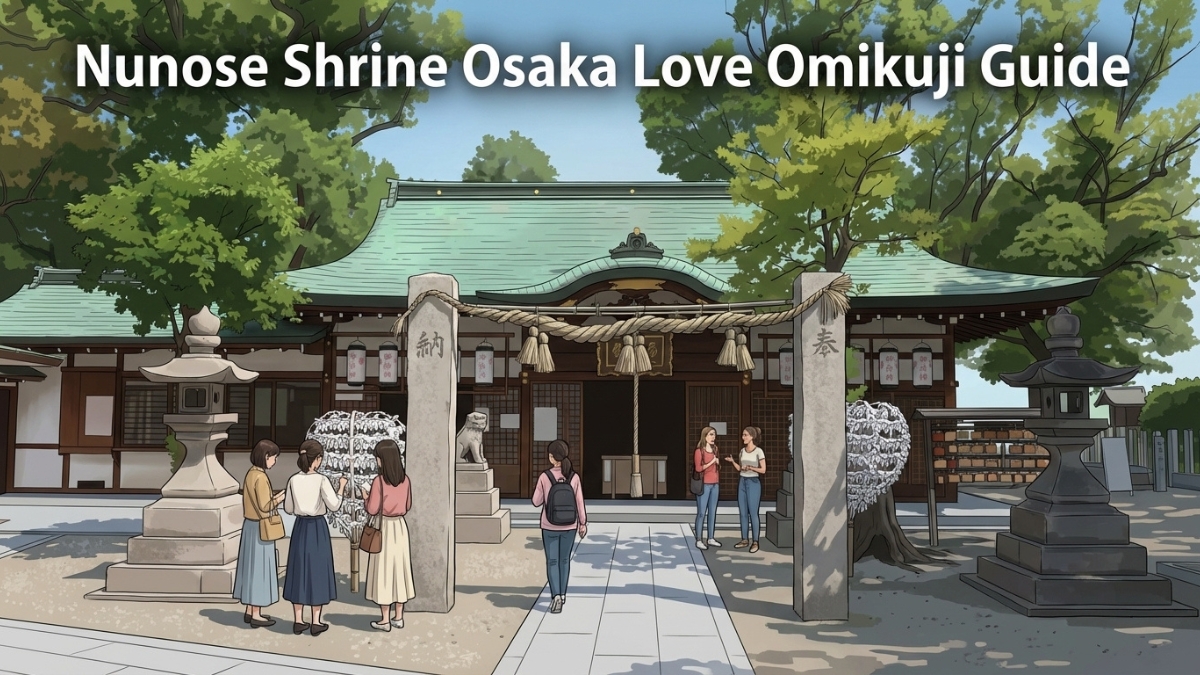
Nunose Shrine is a historic Shinto shrine in Matsubara, Osaka Prefecture. It is best known for its love omikuji, a special fortune slip created in collaboration with contemporary artist Hiroko Ichihara. The shrine is also known for blessings related to love, recovery from illness, warding off bad luck, and general well-being. Its main hall is designated as a tangible cultural property by Osaka Prefecture.
The setting is quiet and residential. This is not a large tourist complex in the middle of Osaka. You leave the station, walk through an ordinary neighborhood, and soon reach a traditional shrine with a calm, local atmosphere. That contrast is part of what makes the visit memorable.
First, what is omikuji?
Omikuji are fortune slips you can draw at shrines and temples in Japan. In many places, they show a luck ranking such as great luck, good luck, or bad luck, and then give short advice about topics such as love, work, travel, or health. The usual fee is around 100 to 200 yen, though the method and price can vary by site.
A common question from overseas visitors is what to do after reading one. In Japan, some people take a good fortune home, while others tie a bad fortune at the shrine in a designated place. Customs differ by shrine, so it is best to follow local signs or staff instructions on the day.
So what is a love omikuji?
A love omikuji is a fortune slip focused on romance and relationships. At Nunose Shrine, however, it works differently from what many visitors expect. These slips do not use the usual good-luck or bad-luck ranking. Instead, each one gives you a short, direct message. The message may feel sharp, funny, uncomfortable, or surprisingly accurate. The point is not to give you a simple score. The point is to make you think.
That is why this shrine became famous. People do not come only to “test their luck.” They come for a message that feels personal, even when it is just a few words on white paper in bold black text.
Why it matters
For many first-time visitors to Japan, standard omikuji can already feel unfamiliar. Nunose Shrine goes a step further. Its love omikuji is widely known because it replaces a normal fortune format with short language-based art. The result feels modern, but the experience is still rooted in shrine culture.
The shrine drew wider attention after the omikuji appeared in a 2017 Google app commercial, and it has continued to spread through Instagram, TikTok, and other social platforms. Even so, it remains a real local shrine first, not a themed attraction. That balance is one reason it still feels authentic when you visit.
What the messages are like
Nunose Shrine’s love omikuji is known for short phrases that can feel blunt, funny, or unsettling. The official shrine site explains that these are message-based fortunes without good or bad rankings.
Some messages are extremely short. Others are longer and more specific. Their meaning depends on your own situation, so two people can read the same phrase in completely different ways. That open interpretation is part of the design.
This also means you should not expect a clear instruction manual. If you prefer a normal fortune with fixed categories and an easy result, this may feel unusual. If you are open to reflection, it can be one of the most distinctive shrine experiences in Osaka.
Who created it?
The love omikuji was created with Hiroko Ichihara, a contemporary artist from Kyoto known for using short Japanese phrases as art. Her work often turns everyday language into something sharp, humorous, and memorable. That style fits the shrine’s love omikuji perfectly.
According to shrine-related information, this collaboration began in 1999, long before many visually designed or social-media-friendly fortunes became common. That makes Nunose Shrine an early and unusual example of a shrine working with contemporary text-based art in a lasting way.
How to get there
Location
Nunose Shrine is in Matsubara, Osaka Prefecture. The address is 2-4-11 Kitashinmachi, Matsubara, Osaka.
Closest station
The nearest station is Nunose Station on the Kintetsu Minami Osaka Line. From the station, the shrine is about 5 minutes on foot.
Easiest route from central Osaka
For most travelers, the simplest route is:
- Go to Osaka Abenobashi Station near Tennoji.
- Take the Kintetsu Minami Osaka Line.
- Get off at Nunose Station.
- Walk about 5 minutes to the shrine.
From Tennoji and Umeda
From Tennoji/Abenobashi, the train ride is short and straightforward. From Umeda/Osaka Station, you usually need to go first to Tennoji, then transfer to the Kintetsu line. Overall, it is an easy half-day stop from central Osaka.
Transfer difficulty
This trip is not hard, but there is one common mistake: do not board a train that skips Nunose Station. If you are starting from Abenobashi, check the train type carefully before you get on.
IC cards
The route is on a major rail line in the Osaka area, so travelers normally use an IC card such as ICOCA, Suica, or PASMO for smooth travel. If you are already using an IC card in Kansai, this is the easiest option.
Opening hours and reception hours
This is one of the most important points.
The shrine grounds open from 6:00 am to 6:00 pm. However, the shrine office and reception for omikuji, goshuin, and charms are from 9:00 am to 5:00 pm. After 5:00 pm, you can still visit the grounds during opening hours, but you cannot draw the omikuji.
Monday closure
The shrine’s official website states that the shrine office is closed on Mondays. On those days, omikuji, goshuin, and charms are not available. If Monday is a public holiday or a monthly festival day, the substitute closure may move to Tuesday instead. This is a key detail for trip planning.
For travelers coming from outside Osaka, it is safest to check the official website, Google Maps, and the shrine’s official Instagram shortly before your visit.
Best time to go
If your goal is to draw the omikuji without stress, go on a weekday morning or early afternoon. The shrine becomes busier during New Year, long holidays, and weekends. Tourist traffic also increased after social media exposure, so peak dates can feel much more crowded than the neighborhood around it suggests.
A good target is to arrive well before 4:30 pm. That gives you enough time to pray, draw the omikuji, and look around without rushing.
Fees and payment
The sources reviewed here clearly confirm the reception hours, access, and closure rules, but they do not clearly confirm the current omikuji fee or accepted payment methods in the same up-to-date official detail. Because prices and handling can change, it is better to check at the shrine office or confirm shortly before your visit on the official channels.
What else to see at the shrine
Even if you came only for the love omikuji, do not leave immediately after drawing it.
Main hall
The shrine’s main hall is an officially recognized cultural property. It gives the visit more depth than a quick social media stop.
Goshuin
If you collect goshuin temple and shrine stamps, Nunose Shrine is also a worthwhile stop. Just remember that goshuin are handled through the shrine office, so timing matters.
Other blessings
The shrine is not only about romance. Local tourism information also notes prayers for illness recovery, protection from misfortune, and prosperity. That broader background helps explain why the shrine still matters to local worshippers, not only visitors looking for a famous love fortune.
Common mistakes to avoid
1. Arriving after 5:00 pm
You may still be able to enter the grounds before 6:00 pm, but you will not be able to draw the omikuji after the reception closes.
2. Going on Monday without checking
Monday closure is the biggest planning trap. And when Monday is a holiday, the closure may shift. Check before you go.
3. Expecting a normal fortune slip
This is not the best place if you want a classic omikuji with an easy ranking and detailed categories. Nunose Shrine’s love omikuji is more interpretive and much more direct.
4. Driving without a parking plan
The official shrine website asks visitors to avoid coming by car when possible because the parking area is small. If you do drive, plan to use nearby paid parking instead of expecting easy shrine parking.
5. Treating it only as a photo stop
Photos are common, but this is still an active shrine. Be respectful, keep noise down, and follow local etiquette around prayer areas and reception spaces.
Local tips for first-time visitors
Pray first, then draw the omikuji. That order feels more natural in a shrine setting.
If you do not read Japanese, it helps to use a translation app after you receive the fortune. Because the messages are short, machine translation is often enough to give you the basic meaning, but the deeper tone may still be open to interpretation.
If your message feels confusing, do not worry. That is part of the experience. Nunose Shrine’s love omikuji is designed less like a fixed verdict and more like a prompt for reflection.
Many visitors choose to take the slip home, especially because the design is memorable and the message may feel worth reading again later. If you see a designated place for tying fortunes and prefer to leave it there, follow the shrine’s instructions on site. Customs vary, so the local method takes priority.
Useful links before you go
Check the official website for the latest opening and closure notices. Use Google Maps for navigation from Nunose Station.
Final takeaway
Nunose Shrine is one of the most unusual shrine visits you can add to an Osaka itinerary. It is easy to reach, small enough for a short visit, and different from the better-known shrine experiences in central Osaka. Most importantly, it is simple to understand once you know one thing in advance: this love omikuji is not about lucky or unlucky. It is about a message.
That makes the visit much easier for first-time travelers. You do not need deep knowledge of Japanese religion to enjoy it. You only need enough practical information to arrive on time, avoid the Monday closure, and understand what kind of experience you are walking into. With that in mind, Nunose Shrine becomes a stop you can visit with confidence.