
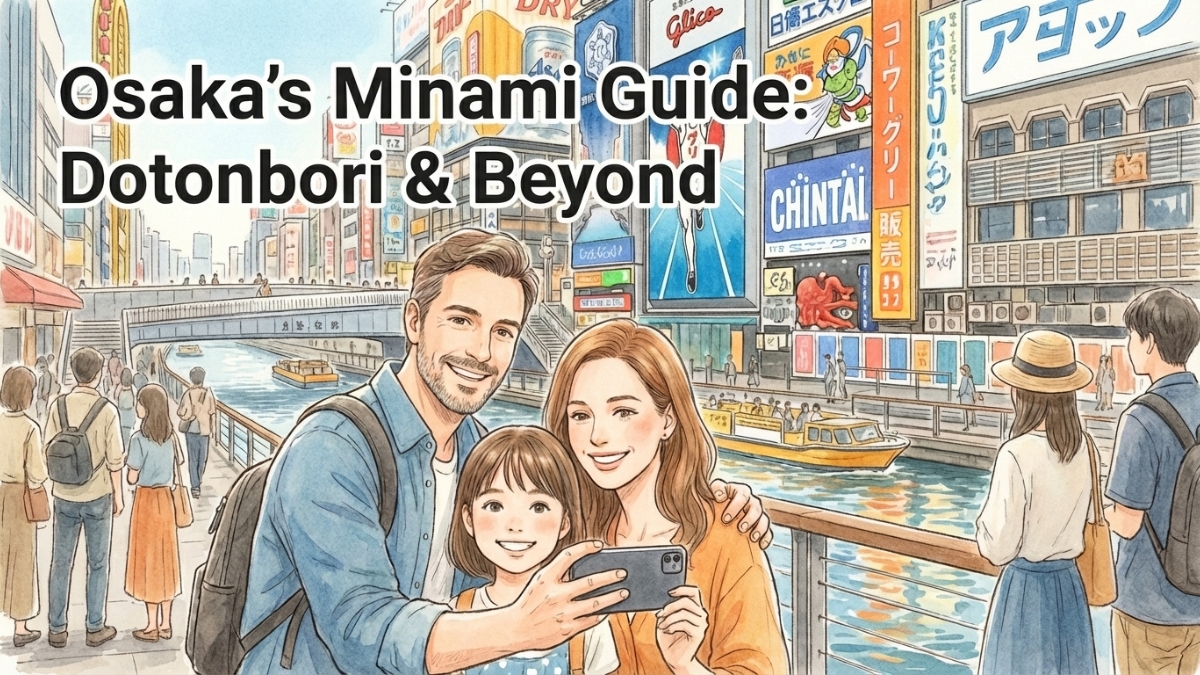
If you are planning your first trip to Osaka, you may hear people say Minami. This can be confusing at first. In Japanese, minami literally means south, but in Osaka it does not mean “the south side” in a simple English map sense. It is not used like a general direction such as “south Osaka,” and it is not an official address name either. In everyday Osaka language, Minami is a local name for the city’s southern downtown entertainment and shopping area, especially around Namba, Shinsaibashi, and Dotonbori.
That is the key point for overseas visitors: Minami is a local urban label, not a formal district name and not just the English word “south.” You will usually understand Osaka much faster if you treat Minami as the name of a well-known city area, in the same way locals do. Once that clicks, station choices, walking routes, and area comparisons become much easier.
What it is
Minami is one of Osaka’s two best-known city centers. The other is Kita, the northern center around Umeda and Osaka Station. Minami is the side of central Osaka that most first-time visitors associate with canal views, neon signs, covered shopping streets, casual food, comedy, and dense street life. Dotonbori is often described as a symbolic district of Minami, and Shinsaibashi-suji is one of the area’s best-known shopping streets.
For practical travel planning, Minami usually means the broad area from Shinsaibashi down to Namba, with Dotonboriin the middle, Amerikamura and Horie to the west, and Nipponbashi to the east. There is no strict official border, so think of it as a shared local definition rather than a fixed administrative line.
Why it matters
This matters because many overseas visitors know the names Namba or Dotonbori, but not the wider term Minami. If you assume Minami is one exact point on the map, you may choose the wrong station, walk farther than expected, or misunderstand what locals mean when they recommend the area.
It also matters because Minami and Kita feel very different. Minami is generally busier, louder, and more street-facing. Kita is more polished, more vertical, and more business-oriented. Neither is “better” in general. They simply suit different travel moods.
How to do it
1) Use Namba as your easiest first base
If this is your first time in Osaka, Namba is the easiest place to use as your anchor inside Minami. It is a major transport hub, and many classic sights are within walking distance. Once you reach Namba, the layout of Minami becomes much easier to understand on foot.
A practical first stop is the tourist desk in the Namba area.
Google Maps: Namba
If you are interested in Osaka’s comedy culture, Namba Grand Kagetsu (NGK) is the city’s best-known theater for manzai and Yoshimoto-style comedy. Most performances are in Japanese, so they can be difficult to follow for first-time visitors.
However, the theater sometimes runs English SHINKIGEKI performances or special shows with English dialogue. These are not regular events, so check the schedule on the official website before planning your visit.
Even when the show is in Japanese, some travelers still choose to stop by the area because the theater is an important part of Osaka’s entertainment culture and is located in the heart of Minami.
Official site: Namba Grand Kagetsu
Google Maps: Namba Grand Kagetsu
If you want a food stop close to Namba, Kuromon Market is an easy addition, but prices have risen noticeably in recent years, especially at stalls aimed at visitors, so it is best to check prices before ordering.
Official site: Kuromon Market
Google Maps: Kuromon Market
Instagram: @kuromonichiba
2) Understand the main areas inside Minami
Shinsaibashi
Shinsaibashi is the main shopping core of Minami. The center of it is Shinsaibashi-suji Shopping Street, a long covered arcade lined with fashion, cosmetics, souvenirs, restaurants, and chain stores. It is one of the easiest places to walk in bad weather because the arcade is covered. It is also a good first route if you want a simple and low-stress walk through Minami.
Google Maps: Shinsaibashi-suji Shopping Street
Dotonbori
Dotonbori is the best-known sightseeing part of Minami. This is where you will find the canal, the bright signs, and the famous photo area near Ebisu Bridge. It is also one of the easiest places in Osaka to recognize immediately, especially at night when the signs reflect on the water and the streets are full of food smells and foot traffic.
Google Maps: Dotonbori
Amerikamura
Amerikamura, often shortened to Amemura, is west of Shinsaibashi and is known for youth culture, vintage clothing, record stores, and a more alternative street feel. It makes a good contrast with the more mainstream shopping atmosphere of Shinsaibashi.
Google Maps: Amerikamura
Horie
Horie feels calmer and more design-focused than central Namba or Dotonbori. It is known for stylish cafés, fashion stores, and interior shops. If Minami starts to feel too crowded, Horie is one of the easiest nearby areas to slow the pace without leaving the district entirely.
Google Maps: Orange Street Horie
Nipponbashi
Nipponbashi is the eastern side of Minami for anime, hobby shops, gaming, and electronics. It is often compared with Akihabara in Tokyo, though the scale and mood are different. It is a useful stop if your interests are pop culture or collectibles rather than general sightseeing.
Google Maps: Nipponbashi
3) Know the easiest walking route
For first-time visitors, the simplest classic route is:
Shinsaibashi Station → Shinsaibashi-suji Shopping Street → Dotonbori → Namba
This route works well because it is easy to follow, has plenty of food and rest stops, and lets you see several versions of Minami in one walk. The covered arcade keeps the walk simple at the start, and the transition into Dotonbori feels natural. From there, Namba is close on foot. The distance from Shinsaibashi toward Namba is manageable for most travelers, though crowds can slow you down.
If you want a quieter detour, step into Hozenji Yokocho near Dotonbori. The narrow stone lane feels very different from the main streets and gives you a more traditional side of the area.
Google Maps: Hozenji Yokocho
4) Get there the easy way
The easiest rail line for many visitors is the Osaka Metro Midosuji Line. It links Shin-Osaka, Umeda, Shinsaibashi, and Namba on one straight line, which makes it the simplest route between Osaka’s main north and south centers.
Google Maps: Namba Station
Google Maps: Shinsaibashi Station
If you are coming from Kansai International Airport, the most direct route into Minami is often the Nankai Railway to Nankai Namba Station. Nankai states that the Limited Express Rapi:t connects Kansai Airport and Nankai Namba in as little as 34 minutes, while Airport Express services also run to Namba.
Google Maps: Nankai Namba Station
For local travel, major IC cards such as ICOCA are practical in Osaka transit and are sold at Kansai Airport stations. Kansai Airport’s official FAQ also notes that ICOCA can be purchased and charged at JR or Nankai Kansai Airport Station.
Common mistakes
Treating “Minami” as if it were just “south”
This is the biggest language mistake. In English, “south” sounds like a direction or a broad side of a city. In Osaka, Minami is a proper local label for a specific downtown area. If you translate it too literally in your head, you may imagine the wrong part of Osaka.
Assuming Namba, Shinsaibashi, and Minami are identical
They are connected, but they are not the same word. Minami is the wider area. Namba and Shinsaibashi are specific parts inside it. If you are meeting someone, booking a hotel, or calling a taxi, the specific station or landmark is usually more useful than just saying “Minami.”
Going at peak time without a plan
Weekends and holidays can be extremely crowded, especially around Ebisu Bridge, Dotonbori, and Shinsaibashi-suji. If you want easier walking or cleaner photos, morning is usually easier than mid-afternoon or early evening.
Carrying large luggage into the busiest part of the area
Namba is a convenient base, but it is also busy. If you have large luggage, use station lockers early, leave bags at your hotel, or plan your first stop carefully. Walking through Dotonbori with a suitcase is possible, but it is not comfortable.
Local tips
If you want the easiest first experience of Minami, start from Shinsaibashi and walk south toward Dotonbori and Namba. That route is intuitive and gives you a good feel for how the district changes from shopping arcade to canal-side sightseeing to transport hub.
If you want the clearest mental shortcut, remember this:
- Minami = the wider local downtown area
- Namba = the easiest base for first-time visitors
- Shinsaibashi = the main shopping core
- Dotonbori = the iconic sightseeing zone
That is the simplest way to avoid confusion.
Final takeaway
For overseas visitors, the most important thing to understand is that Minami may mean “south” in Japanese, but in Osaka it does not function like the plain English word “south.” It is a local name for one of the city’s best-known downtown areas. Once you stop treating it as a simple direction and start treating it as the name of a real travel district, Osaka becomes much easier to navigate.If you arrive through Namba, walk through Shinsaibashi, stop in Dotonbori, and use the official links above for navigation, you will have a much clearer and less stressful first experience of Minami.