
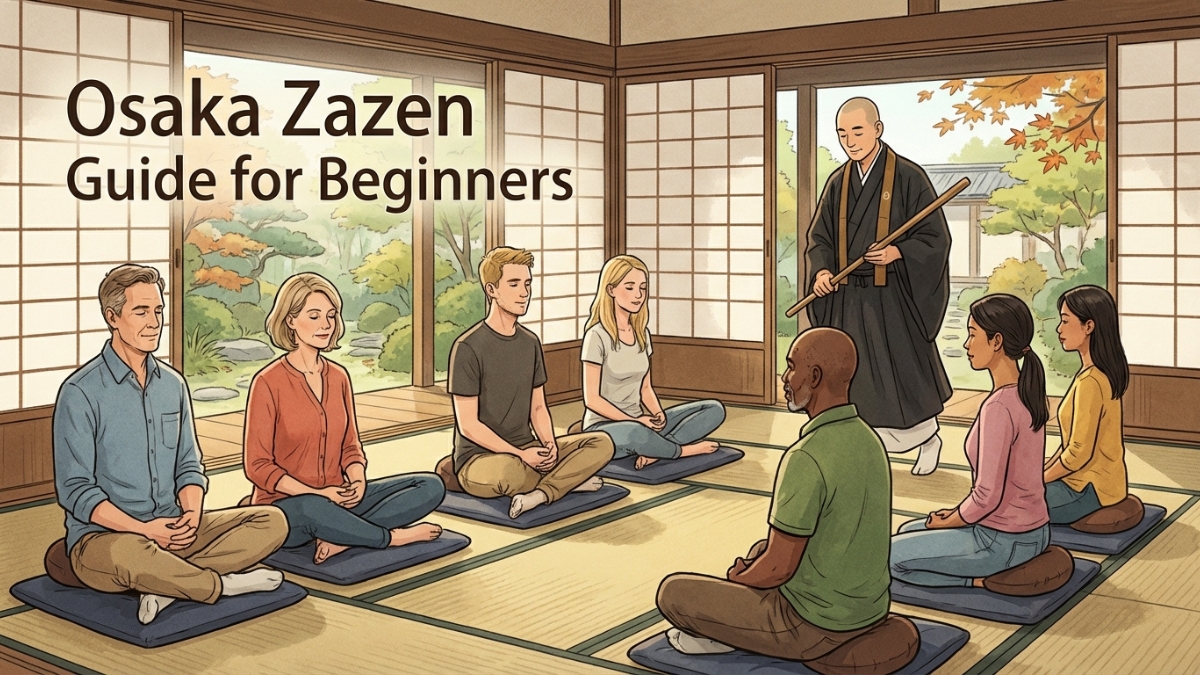
If you want to try zazen in Osaka, you do not need to travel far into the countryside. There are temples in and around the city where beginners can sit quietly, learn the basics, and step out of the normal pace of the day. At the same time, not every temple offers public zazen, and not every session is set up for overseas visitors. Before you go, check the official website or contact the temple directly. Some temples may not accept foreign visitors for a session because they cannot provide enough English support or do not have the right format for first-time non-Japanese speakers. That is usually a practical issue, not a personal one. The official Soto Zen guidance for foreign visitors also says to confirm the date, clothing, and other details directly with the temple before attending.
Useful links: Soto Zen official foreigner-friendly temple guide
What it is
Zazen is seated in Zen meditation. In practice, it usually means sitting still, working with posture and breathing, and letting the mind settle without chasing every thought. In Osaka, public sessions range from very approachable beginner events to more serious temple-based practice. Some are held regularly every week. Others require you to contact the temple and arrange a private session.
For first-time visitors, the most important point is to choose the right type of temple. If you need English support, choose a place that clearly says so. If you want an easy first experience in Japanese, choose a temple that explains posture to beginners and allows chairs. If you want something more formal, choose a temple with a stronger Zen training atmosphere and contact them before you go.
Why it matters
The main reason to plan carefully is simple: Osaka does have good zazen options, but they do not all work the same way. One temple may welcome beginners without reservation. Another may require advance booking. Another may only be realistic for Japanese speakers unless you arrange a private English session. Official temple pages make these differences clear, and they matter.
This matters even more for overseas visitors. It is easy to assume that any temple advertising meditation will be able to receive international guests, but that is not always true. The safest approach is to use official pages, not old blog posts, and to contact the temple directly if anything is unclear.
How to do it
1) Choose the right temple
Tenshoji Temple, Tennoji
Tenshoji is one of the clearest options if you need English support. The temple’s English page says it offers private zazen sessions for people who do not speak Japanese, and that if you want a zazen session in English, the temple will arrange a mutually convenient date and time. The participation fee starts from 2,000 yen per person, payment can be made by cash or credit card, and the temple asks you to contact them by email with your preferred date and time.
The temple is in Tennoji Ward, near Shitennoji. Its access page says it is about a 7-minute walk from Shitennoji-mae-Yuhigaoka Station, about 12 minutes from JR Tennoji or Momodani, and about 15 minutes from Osaka-Uehommachi Station. If you want a more careful, lower-stress first experience, this is one of the strongest choices in Osaka because the temple explicitly explains how it handles English-speaking guests.
For Tenshoji, the easiest access is usually Osaka Metro Tanimachi Line to Shitennoji-mae-Yuhigaoka Station, then a walk of about seven minutes. The temple’s access page also notes JR Tennoji and Osaka-Uehommachi as alternatives, but those walks are longer.
Tenshoji: private English sessions by arrangement, from 2,000 yen per person, cash or credit card, email booking required.
Official site: Tenshoji Temple
Google Maps: Tenshoji Temple
Nozaki Kannon Jigenji, Daito
If you want a beginner-friendly public session and you are comfortable joining in Japanese, Nozaki Kannon Jigenji is one of the best official options near Osaka. Its zazen page says anyone can join, reservation is not required, and first-time participants are given about 20 minutes of explanation before sitting. The temple also says chair zazen is possible for people who cannot sit cross-legged, and beginners should arrive about 10 minutes early.
The regular zazen meeting is held every Sunday from 8:00 a.m. to 9:00 a.m., followed by a talk and tea until shortly before 10:00 a.m. The donation is 500 yen. The temple recommends loose trousers rather than a skirt, and says you can come empty-handed. For a first visit, that makes it one of the easiest practical choices.
For Nozaki Kannon, the temple’s zazen page does not focus on station-by-station directions on the excerpt above, so use the official access page or Google Maps before you leave your hotel. Because this session does not require a reservation, it is tempting to improvise, but you should still check the route carefully the night before.
Nozaki Kannon Jigenji: every Sunday, 8:00 a.m. to about 10:00 a.m. including talk and tea, 500 yen donation, no reservation required.
Official site: Nozaki Kannon Jigenji
Google Maps: Nozaki Kannon Jigenji
Shitennoji Takayasuyama Cemetery zazen and meditation gathering
This is not the main Shitennoji grounds in central Tennoji, so it is less convenient than the two options above, but it is an official Shitennoji program and worth knowing about. Shitennoji’s official notice says the main temple’s zazen meeting is currently suspended, but a monthly “zazen and meditation gathering” is held at the Shitennoji Takayasuyama Cemetery branch on the first Saturday of each month. It is fully reservation-only, costs 1,000 yen, and the staff provide transport from Oji Station by small bus if needed.
For the Shitennoji Takayasuyama event, the official notice says the meeting point for the staff shuttle is the rotary at Oji Station, and that car access is also possible. Since this is not central Osaka, plan extra travel time.
Shitennoji Takayasuyama: first Saturday of each month, 1,000 yen, full reservation required.
This option suits travelers who want a more structured and formal program and who do not mind traveling outside central Osaka. Because it is reservation-only and transport is coordinated directly with staff, you should not treat it as a casual same-day option.
Official site: Shitennoji
Google Maps: Shitennoji Takayasuyama Cemetery
2) Wear the right clothes
For zazen, the safest clothing choice is simple: wear loose trousers and avoid anything tight, noisy, or distracting. Nozaki Kannon’s official guidance recommends relaxed trousers, says women should not wear short tight skirts, and notes that participants may be asked to sit barefoot if possible.
That advice works well everywhere. Avoid heavy accessories, strong perfume, and clothing that makes noise when you move. Bring socks that are easy to remove if needed. If you are coming from sightseeing, it is worth changing before the session rather than trying to sit in jeans.
3) Understand the basic style before you go
If you cannot sit cross-legged, do not assume you have to give up. Nozaki Kannon explicitly says chair zazen is available, and that there are different leg positions for people who need a gentler option.
If you are worried about being hit with the warning stick, that fear is usually bigger than the reality in beginner sessions. Public introductory zazen is generally much more approachable than many people expect. The larger issue is not fear, but whether the temple is running the session in a way you can actually follow. That is why language and format matter so much.
Common mistakes
Assuming all temples welcome overseas visitors the same way
They do not. Some temples can offer English guidance. Some can only manage Japanese-language instruction. Some may decide not to accept foreign guests if they cannot run the session properly for them. That is why direct confirmation matters so much. The official Soto Zen guidance also tells first-time participants to confirm schedule, clothing, and other conditions directly with the host temple.
Turning up without checking the latest schedule
Temple programs can change because of memorial services, seasonal events, or internal temple reasons. This is especially important in Japan, where a website may list a regular schedule but a specific date can still be canceled or adjusted. Always check the official page or contact the temple directly before leaving.
Wearing tight or flashy clothing
This is a practical mistake, not a style mistake. Tight clothes make posture harder. Bright or noisy clothing distracts you and other participants. Temples that welcome beginners usually say this clearly, and they are right.
Expecting every session to teach beginners from zero
Some do. Some do not. Nozaki Kannon clearly says it gives beginners an explanation before sitting. Tenshoji clearly says English sessions can be arranged privately. That kind of explicit wording is what you should look for. If a temple page does not explain how beginners are handled, ask before you go.
Local tips
If you want the least stressful first experience, choose one of these two patterns.
If you need English, contact Tenshoji first. It is the clearest official option in Osaka for arranging an English-language zazen session.
If you do not need English and want a very approachable public session, go to Nozaki Kannon Jigenji on a Sunday morning. The temple explains posture to beginners, allows chair zazen, and does not require a reservation.
If you want something more formal and do not mind extra travel, Shitennoji’s Takayasuyama program is worth considering, but treat it as a planned half-day experience, not a quick stop.
Finally, if a temple says no, take that at face value and move on respectfully. In many cases, the issue is simply that the temple cannot support visitors in English or cannot run a proper first-time session under its current conditions. It is better to choose a temple that is ready for you than to force a visit that will be uncomfortable for everyone.
Final takeaway
You can try zazen in Osaka as a beginner, but the best temple depends on what kind of help you need. Tenshoji is the strongest official choice for visitors who want English support and are happy to arrange a private session. Nozaki Kannon Jigenji is one of the easiest public options for beginners, with no reservation, clear explanations, chair seating, and a low donation. Shitennoji’s Takayasuyama program is a more formal reservation-only option.
The safest approach is simple: pick a temple that matches your language needs, wear loose clothing, arrive early, and confirm the latest rules directly with the temple. That is the easiest way to try zazen in Osaka without confusion.