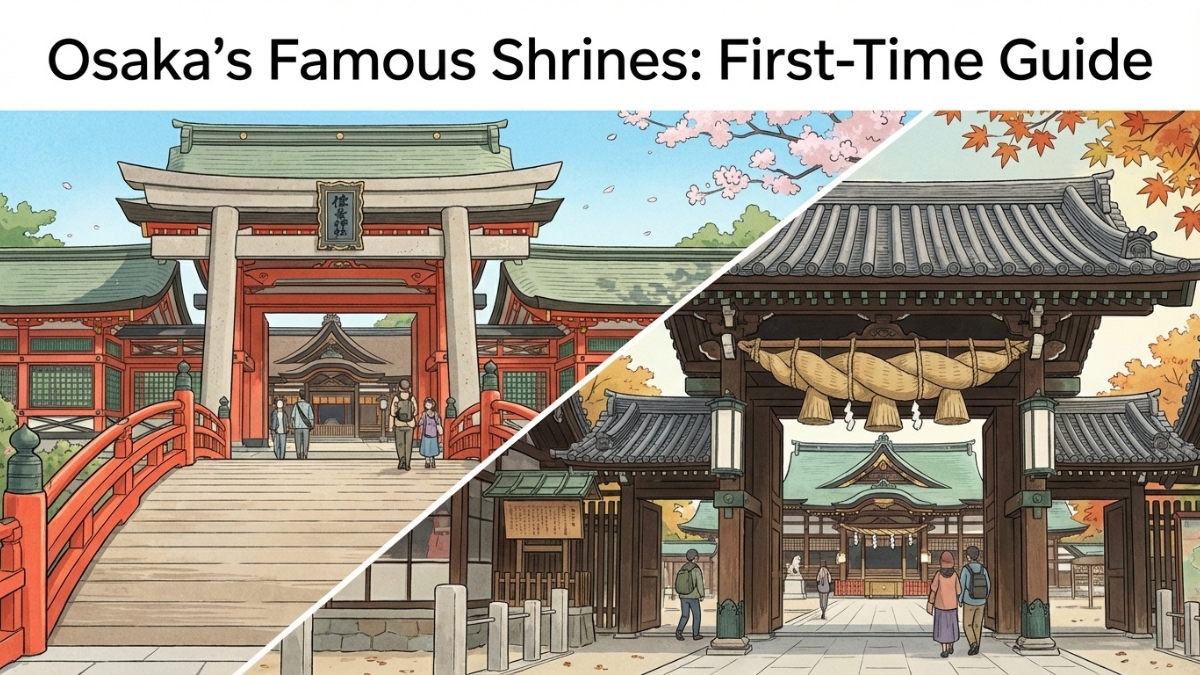
Osaka has many well-known shrines, from major historic sites like Sumiyoshi Taisha to smaller urban shrines such as Tsuyunoten Shrine (Ohatsu Tenjin) in Umeda. Some are famous for business luck, some for study success, some for love, and some simply for their strong local identity. For first-time visitors, the easiest way to plan is to choose by area and purpose rather than trying to visit everything in one day. Osaka’s official tourism guide is a good starting point if you want to confirm access and current visitor information before you go.
This guide focuses on the most famous shrines in Osaka, what they are best known for, and which ones are the easiest to combine with sightseeing. It is designed for visitors who want clear, practical information and do not want to waste time on the wrong detour.
What it is
A shrine visit in Osaka is not only about religion. It is also a way to understand the city. Osaka’s major shrines are tied to trade, sea travel, scholarship, local festivals, and the history of the city itself. Some sit in quiet residential districts. Others are right next to busy shopping streets or major stations. That contrast is part of what makes shrine visits in Osaka interesting.
Many travelers also visit for practical reasons. Some want a shrine connected with business luck. Others want a place associated with exams, relationships, or healing. If that is your goal, Osaka is easy to navigate because the better-known shrines each have a fairly clear identity.
Why it matters
The main planning mistake is treating all shrines as interchangeable. They are not. Sumiyoshi Taisha is one of Osaka’s most important historic shrines and is strongly connected with the sea and with Osaka’s older identity. Osaka Tenmangu is closely associated with learning and is one of the key sites of the Tenjin Festival. Imamiya Ebisu Shrine is the best-known choice for business prosperity. Namba Yasaka Shrine is popular for its giant lion-head stage and its unusual look. Ishikiri Tsurugiya Shrine is especially known for prayers for healing and for its repeated walking prayer ritual.
For a first trip to Osaka, that means your route should follow your interests. If you want history, choose one of the older major shrines. If you want an easy stop near shopping or nightlife, choose a city-center shrine. If you want a more local atmosphere, go farther from central Osaka.
How to do it
1) Choose by area first
South Osaka: Sumiyoshi Taisha
If you want the most famous and historically important shrine in Osaka, start here. Sumiyoshi Taisha is the head shrine of about 2,300 Sumiyoshi shrines across Japan. It is especially associated with the sea, safe voyages, business, love, and safe childbirth, and it is also famous for its distinctive architecture and major festivals. It is one of the strongest choices if you want a shrine that feels unquestionably important rather than simply photogenic. The official site also notes that around two million people visit for New Year prayers each January.
The shrine is famous for its arched bridge, often called the Sorihashi Bridge, and for the four main shrines built in the traditional Sumiyoshi style. It works well as a half-day visit, especially if you want a slower pace than central Umeda or Namba.
Official site: Sumiyoshi Taisha
Google Maps: Sumiyoshi Taisha
North Osaka / Umeda: Osaka Tenmangu
If you are staying near Osaka Station or Umeda, Osaka Tenmangu is the most practical major shrine to visit. It was founded in 949 and is dedicated to Sugawara no Michizane, the deity associated with learning. It is best known today for exam-related prayers and for the Tenjin Festival, one of Japan’s most famous traditional festivals.
This shrine is a good choice if you want a shrine visit without leaving the city center. It also combines easily with the Tenjinbashisuji shopping street area.
Official site(Japanese): Osaka Tenmangu
Google Maps: Osaka Tenmangu
Namba area: Namba Yasaka Shrine
If you want something visually striking and easy to add to a Namba itinerary, go to Namba Yasaka Shrine. It is best known for the giant lion-head stage, which is said to swallow evil spirits and bring good luck or victory. The shrine is about a 6-minute walk from Namba Station and is open year-round. The gate hours listed by Osaka Info are 6:00 a.m. to 5:00 p.m., with office hours from 9:00 a.m. to 4:50 p.m.
This is one of the easiest shrines to visit if you are already in Namba, but it is more about atmosphere and visual impact than large shrine grounds.
Official site(Japanese): Namba Yasaka Shrine
Google Maps: Namba Yasaka Shrine
Umeda area: Tsuyunoten Shrine (Ohatsu Tenjin)
If you want a smaller shrine in a very central location, Tsuyunoten Shrine, usually called Ohatsu Tenjin, is a good choice. It sits at the end of the Ohatsutenjin shopping street and is known as the setting of Sonezaki Shinjū by Chikamatsu Monzaemon. Osaka Info describes it as a power spot for love and notes that it has a history of more than 1,300 years.
Because it is close to restaurants, bars, and shopping in Umeda, this is one of the easiest shrines to visit in the evening or between other activities. It is a good choice if you want a short visit with a strong literary and local connection.
Official site: Tsuyunoten Shrine
Google Maps: Tsuyunoten Shrine
Business and New Year luck: Imamiya Ebisu Shrine
If your main interest is business luck, this is the key shrine. Imamiya Ebisu Shrine is dedicated to Ebisu, the deity strongly associated in Osaka with trade and commerce. It is especially famous for the Tōka Ebisu festival around January 10, when many visitors come to pray for prosperity in the new year.
Outside festival dates, it is a straightforward shrine visit. During the January festival period, it becomes one of the liveliest examples of Osaka shrine culture.
Official site: Imamiya Ebisu Shrine
Google Maps: Imamiya Ebisu Shrine
East Osaka: Ishikiri Tsurugiya Shrine
If you want a shrine known for healing prayers and a more local atmosphere, go to Ishikiri Tsurugiya Shrine. Osaka Info says it is nationally known as the “god of swellings,” and it is especially famous for ohyaku-do mairi, a repeated back-and-forth prayer practice. Access is about 15 minutes on foot from Ishikiri Station or 7 minutes from Shin-Ishikiri Station. Worship is free.
This is a stronger choice than the city-center shrines if you want something that feels more rooted in everyday local belief. The shopping street approach also has an older atmosphere that feels very different from central Osaka.
Official site: Ishikiri Tsurugiya Shrine
Google Maps: Ishikiri Tsurugiya Shrine
2) Add a shrine that matches your purpose
If you want:
- history and major status: Sumiyoshi Taisha
- study success: Osaka Tenmangu
- business prosperity: Imamiya Ebisu Shrine
- love-related visits in central Osaka: Tsuyunoten Shrine
- dramatic photos and a quick Namba stop: Namba Yasaka Shrine
- healing prayers or a more local feeling: Ishikiri Tsurugiya Shrine
That simple approach is usually better than trying to visit too many shrines in one day.
3) Know a few other important names
If you want to go deeper than the most famous six, these are also worth knowing:
Toyokuni Shrine in Osaka Castle Park is associated with career success and good fortune and enshrines Hideyoshi, Hideyori, and Hidenaga. It is very easy to combine with Osaka Castle sightseeing.
Ikutama Shrine in Tennoji is one of Osaka’s older shrines and is a short walk from Tanimachi 9-chome Station. Osaka Info lists visiting hours as 9:00 a.m. to 5:00 p.m., though they may vary by season.
Hiraoka Shrine in Higashiosaka is often called Moto-Kasuga, with direct access right by Hiraoka Station on the Kintetsu Nara Line.
Ōtori Taisha in Sakai is another old high-ranking shrine. Osaka Info says it is about a 5-minute walk from JR Ōtori Station, with opening hours that change slightly by season.
Common mistakes
Trying to visit too many shrines in one day
This is the most common planning mistake. Osaka is spread out, and while public transport is good, shrine visits take longer than many visitors expect. If you try to do five or six major shrines in one day, the visits can become rushed and shallow.
Choosing only by popularity
The most famous shrine is not always the best shrine for your route. If you are already in Umeda, Osaka Tenmangu or Tsuyunoten Shrine may make more sense than crossing the city. If you are already visiting Osaka Castle, Toyokuni Shrine is an easy addition. Practical route planning matters.
Ignoring office hours for goshuin or charms
Many shrine grounds can be visited freely, but goshuin reception, amulet counters, and shrine offices may have shorter hours than the grounds themselves. If collecting goshuin matters to you, check the official site before you go.
Treating goshuin like a stamp collection only
In Japan, a goshuin is understood as proof of worship, not just a souvenir. It is better to pray first, then receive the goshuin.
Assuming every shrine has strong English support
Some of Osaka’s major shrines have English pages or strong tourism support, but many smaller shrines do not. Save the shrine name and location before leaving your hotel.
Local tips
If this is your first shrine visit in Japan, keep the etiquette simple. Walk calmly, avoid loud phone calls, and do not stand in the middle of worship areas for photos. If there is a purification fountain, watch how others use it before trying. You do not need to perform everything perfectly to be respectful.
If you want the easiest shrine route for a first Osaka trip, one of these works well:
Central city route: Osaka Tenmangu + Tsuyunoten Shrine
South Osaka route: Sumiyoshi Taisha + Namba Yasaka Shrine
Eastern route: Ishikiri Tsurugiya Shrine + Hiraoka Shrine
For many travelers, Sumiyoshi Taisha is the single best first choice because it feels unmistakably important and distinctly Osaka. If you only have time for one shrine, that is usually the safest recommendation.
If you are more interested in city atmosphere than scale, Tsuyunoten Shrine is the easiest shrine to add without changing your day too much. If you want a shrine that will stand out in photos, Namba Yasaka Shrine is the obvious choice. If you want a shrine visit tied to a personal wish, choose by purpose rather than by size.
Final takeaway
The most famous shrines in Osaka are not all the same, and that is exactly why they are worth visiting. Sumiyoshi Taisha is the city’s strongest all-round historic shrine. Osaka Tenmangu is the clearest choice for study-related visits. Imamiya Ebisu Shrine is the best-known business shrine. Tsuyunoten Shrine works well for love-related visits in central Osaka. Namba Yasaka Shrine stands out for its giant lion-head stage. Ishikiri Tsurugiya Shrine is the clearest choice for healing-related prayers.
For a first visit, do not try to do everything. Pick one or two shrines that match your route and your reason for going. That is the easiest way to enjoy Osaka’s shrine culture without confusion.